Author: Grace Forrest

  • 7 Foods You Need to Try While Living in South Korea

    7 Foods You Need to Try While Living in South Korea

    I have been teaching English in South Korea for six months now and I have experienced countless amazing Korean foods. Let’s face it, the food is one of my favorite things about living in Korea! Eating Korean is all about the experience. Meals are savored and cherished, and going to dinner is definitely the activity I find myself enjoying the most. Beware! A lot of Korean food is known for its spiciness, and you will impress your Korean friends and coworkers if you can handle that spice!

    This brings to me to a very important statement: Korean food is all about sharing. It’s very uncommon for a group of Koreans to go out to eat and not share every piece of food. If you are used to only ordering food for yourself and not sharing, get ready for a new dining experience because many restaurants and portions at grocery stores assume you are going to share a lot of food with whomever you are with or are cooking for.
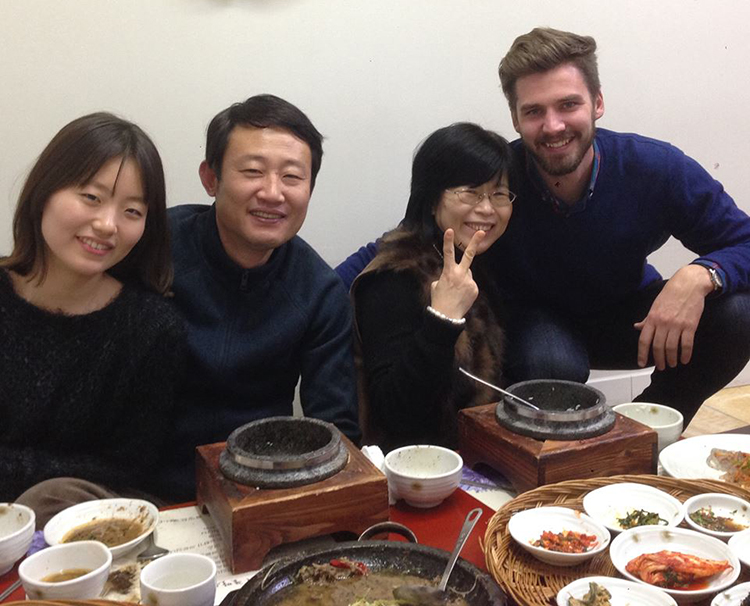
    Sharing food is difficult for my two vegetarian friends because us meat-eaters usually want… Meat. We somehow make it work, and are still friends after six months in Korea. Luckily, both of them eat fish and seafood (this isn’t the only reason we’re still friends, by the way!), but another thing to know about eating in Korea is that many dishes are made with meat or seafood (beware jjajangmyun – black bean noodles is misleading).

    We live in a city and it has been okay finding western-style restaurants with vegetarian options where we can all order our own foods, but most of the real “Korean dining experiences” are centered around meat.

    Below is the list of my favorite quintessential Korean foods you simply MUST try while in Korea:

    #7. Pajeon – Onion pancake

    A seafood pajeon ready to eat.

    Korean style pancakes are likely not the same breakfast pancakes you have at home. Jeon (pancake) is savory, oily, delicious, and filled with vegetables, kimchi, or seafood. These are great options for vegetarians to share in the meals. The pancake comes out and everyone picks at it with their chopsticks.

    #6. Dalgona – Sugar… Just sugar
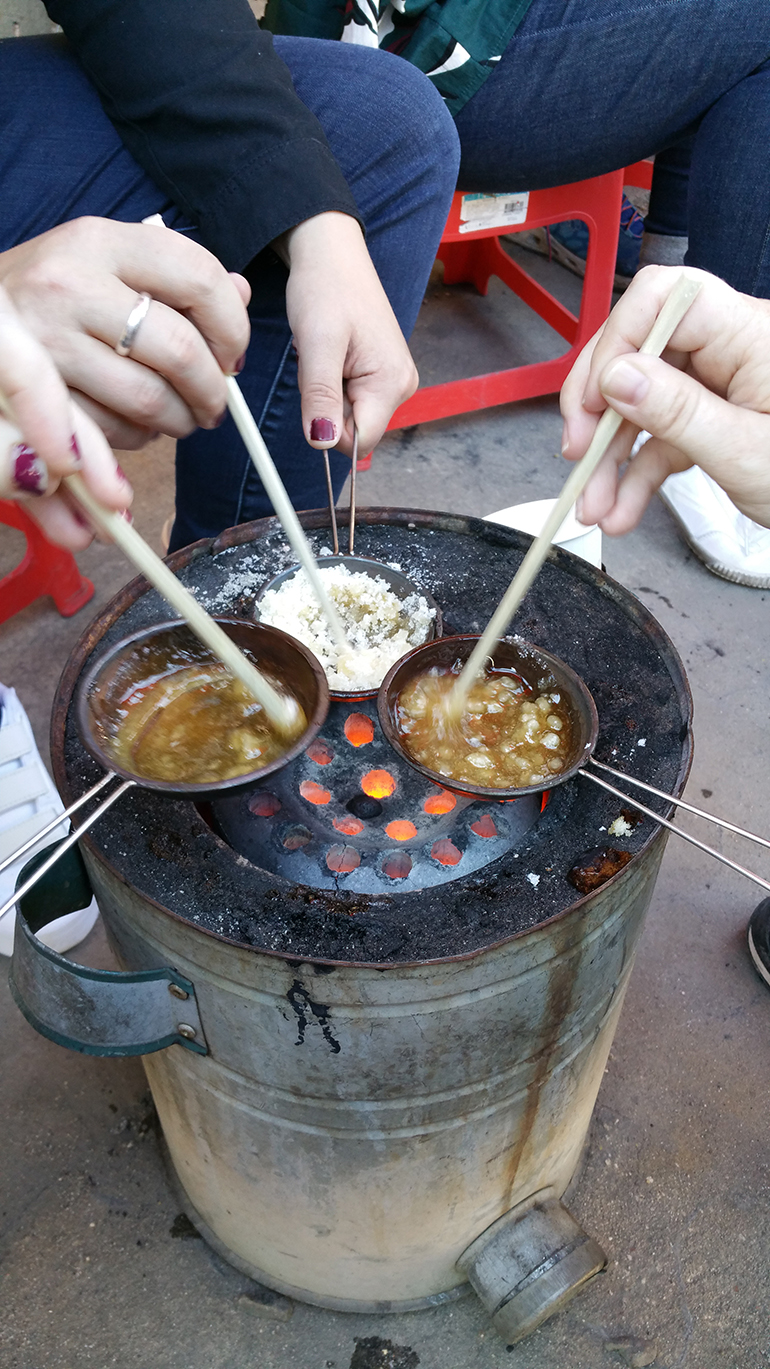
    Making dalgona at a street stand.

    Another street food is dalgona. I included this in the must-have when coming to Korea list because it’s so unique. The only components of dalgona are sugar and baking soda! That’s it. The method of which you make it, though, is why this is a must-eat food. You heat a small bowl filled with sugar over a fire and constantly stir the sugar.

    Once it gets to a melted stage, you add a little bit of baking soda and then pour the mixture onto a flat surface. A worker at the stall will stamp a design into the sugar once it starts to harden. The whole point of dalgona is trying to pick out the stamped design with a toothpick without breaking the fragile sugar mold. If you get the design out, unbroken, you get a prize! I broke mine, unfortunately…
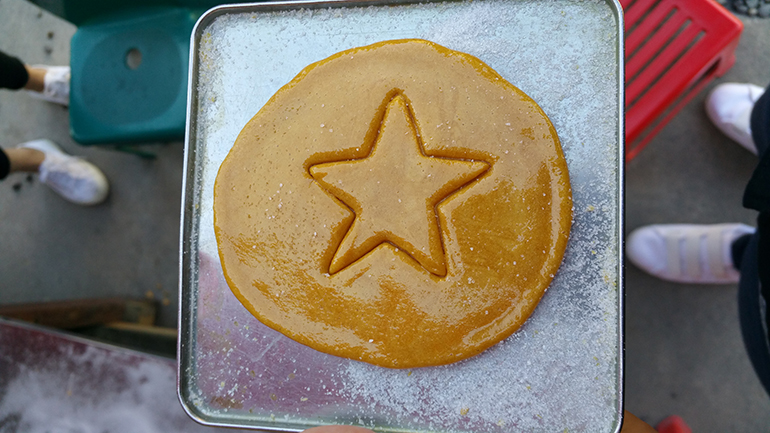
    My finished design ready for eating.

    #5. Picnic Foods – Japchae and Kimbap – Sweet potato noodles with beef and vegetables and seaweed wrapped with meat and vegetables

    Japchae is my favorite cold Korean dish. You can get it as a side dish, but it’s more common to find at big Korean gatherings. It’s a very popular picnic food since you make it in huge batches, and it’s great served cold. The method of cooking the beef is mouth-wateringly amazing! Sauté the beef with sugar, oil, and onions and magic happens!
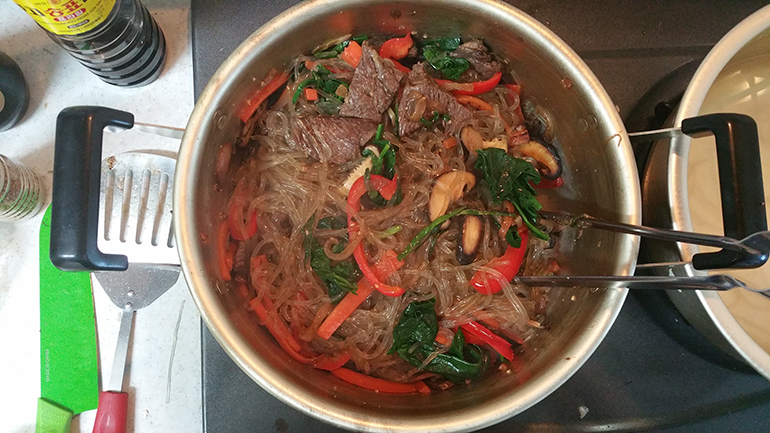
    A delicious batch of homemade japchae.

    Another popular picnic food is kimbap which is similar to a sushi roll – meat and veggies and radish rolled into a seaweed wrap, then cut into discs. I have made both of these dishes at home and they are my favorite two dishes to make because of how easy they are to put together. Also, I love how I can make a massive batch of both, and they stay good for a week or so. Leftovers for days!
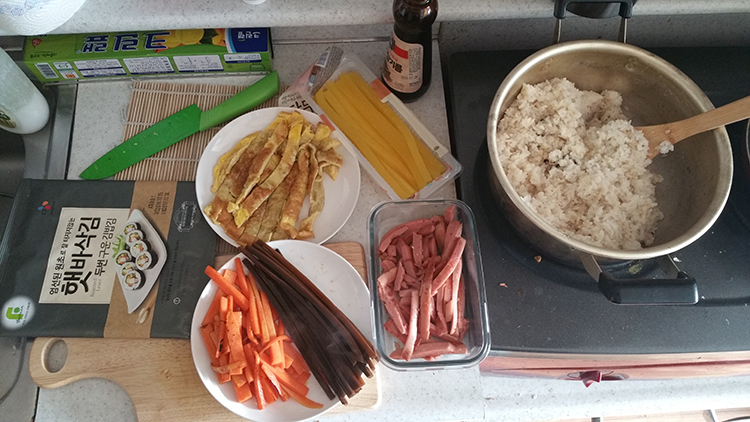
    Getting ready to make kimbap.

    #4. Ddeokbokki – Spicy rice cakes

    If you’ve heard of any Korean food, it’s probably ddeokbokki. No list of must-have foods in Korea would be complete without this insanely popular street food. Rice cakes smothered in spicy red sauce, ddeokbokki is certainly the most “Korean” tasting food I’ve had. Koreans use gochujang (red pepper paste) in many of their dishes, and you really get that strong gochujang taste in this dish. Ddeokbokki is not only popular with foreigners, but also Koreans; you will see many students at ddeokbokki shops and stalls after school.

    #3. Bungeo-ppang – Fish-shaped bread with cream or red bean filling

    How do I describe bungeo-ppang? Just thinking about the fish-shaped bread filled with cream makes my mouth water. This is my favorite sweet treat. Since bungeo-ppang is a street food, it’s sometimes hard to find. Luckily (or maybe not!), a man has set up his cart on my way home from school. I go there so often, he knows my order – 3 breads filled with cream. The best part is eating them on the walk home because they are so warm and soft. The red bean variety is also sensational, yet a tad more filling. There’s really no describing how amazing bungeo-ppang makes me feel.

    #2. Chimaek – Fried chicken and beer

    Getting fancy with my fried chicken.

    Chimaek or chicken and maekju (beer) is one of my favorite comfort food combos here in Korea. Chicken? You might be asking. I can get that anywhere! Believe me, the chicken here is SO MUCH BETTER than where you’ve had it before. Koreans really know how to make chicken. I ate chicken wings consistently (weekly!) in America, but the boneless chicken (called soonsal) here is unbelievable! You can order tons of different sauces and toppings.

    My favorite chicken place is called Outdark and I always order the Spicy Lindfield flavor. Be sure to order beer as well for the FULL, sensational chimaek experience.

    #1. Samgyeopsal – Grilled pork belly
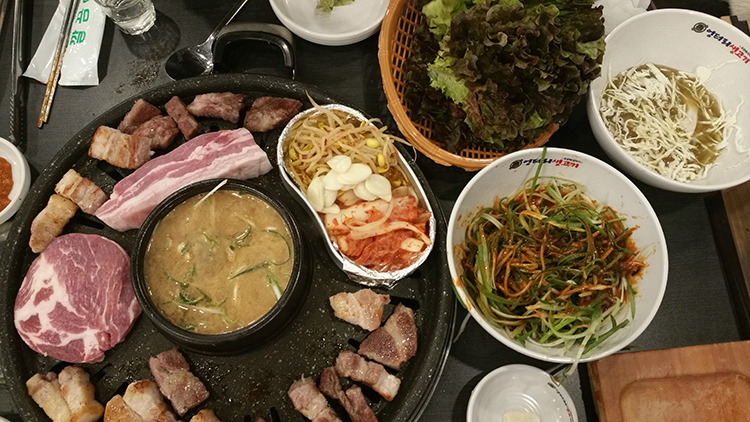
    Samgyeopsal is my ultimate favorite food in Korea. It is maybe the most popular meal to eat together with your friends, and most Koreans cherish the experience of gathering and eating tons of meat. (Yes, there’s all-you-can-eat places!) They call the places where you cook your own meat gogi chip (meat house – very subtle, I know).

    The set-up: You order however much meat you want (usually, restaurants will only serve either all pork or all beef) and sit around a large grill with a vent. The waitstaff will bring you what you order along with many other side dishes and sauces, then you cook the meat yourself! So, at first I was really intimidated to cook my own meat, but once you get the hang of how long it takes for the different thickness of the meat to cook, it’s so satisfying to do on your own. You also get to cut it to the size you want!
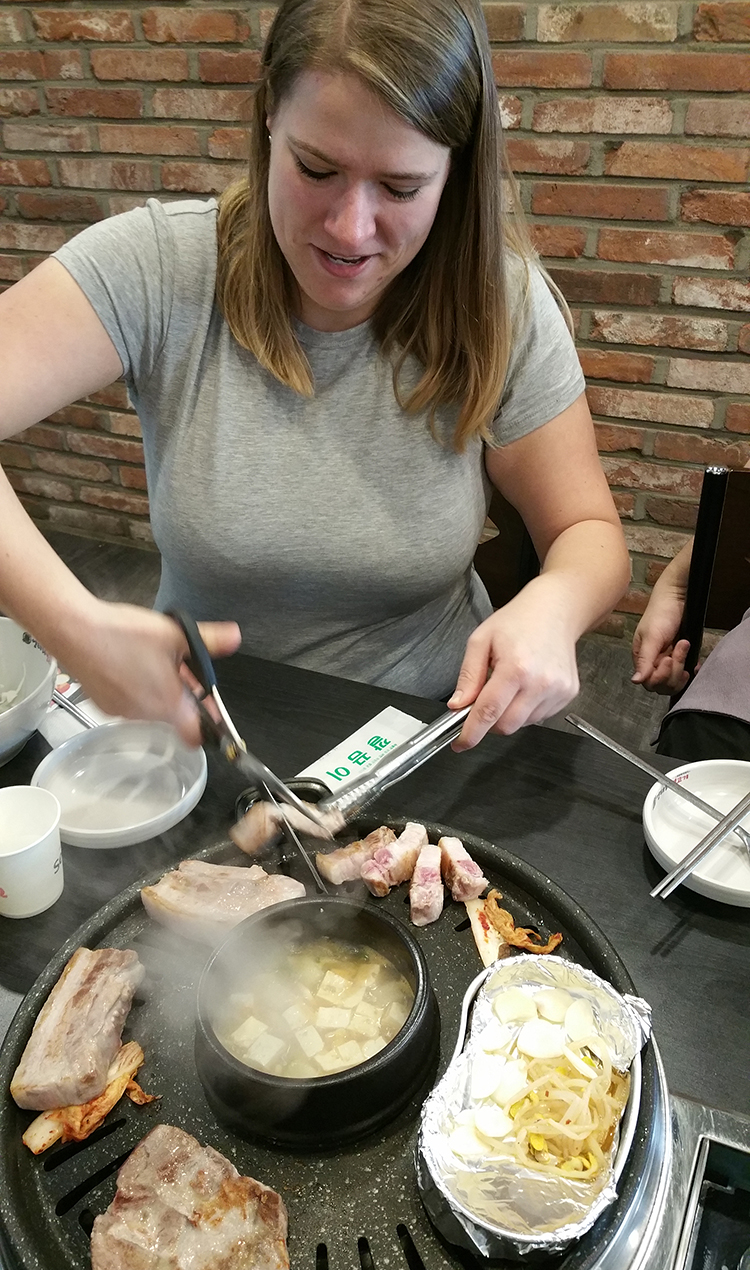
    Cutting my portions of meat in this interactive dining experience.

    A popular phrase that Koreans like to say is “soju* and samgyeopsal are best friends”, so if you’re up for it, order a bottle of soju, too!

    *Soju isn’t a food, but I would’ve included it on this list.

    Soju is Korean rice liquor and the most popular alcoholic drink in Korea.

    If you drink alcohol, I would recommend acquiring a taste for soju. I say this because the majority of the twenty-something-aged friends you’ll make will be REALLY impressed if you drink soju. Don’t like the taste? Don’t worry! There’s fruit-flavored soju! Also, soju in juice-boxes! Or, it goes well with just about any mixer.
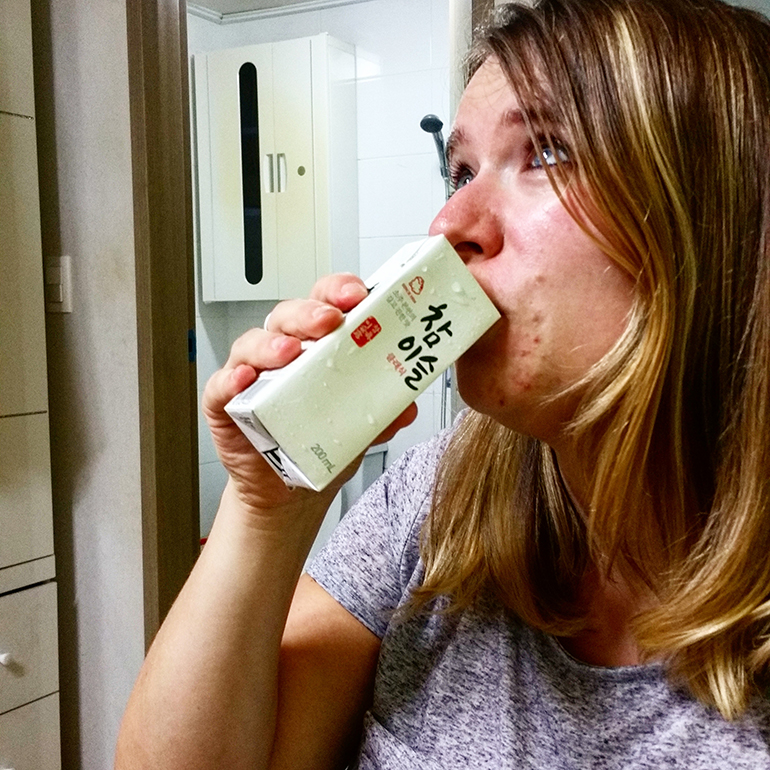
    No big deal, just drinking soju from a convenient juice box.

    There are a few Korean foods I felt deserved honorable mentions:

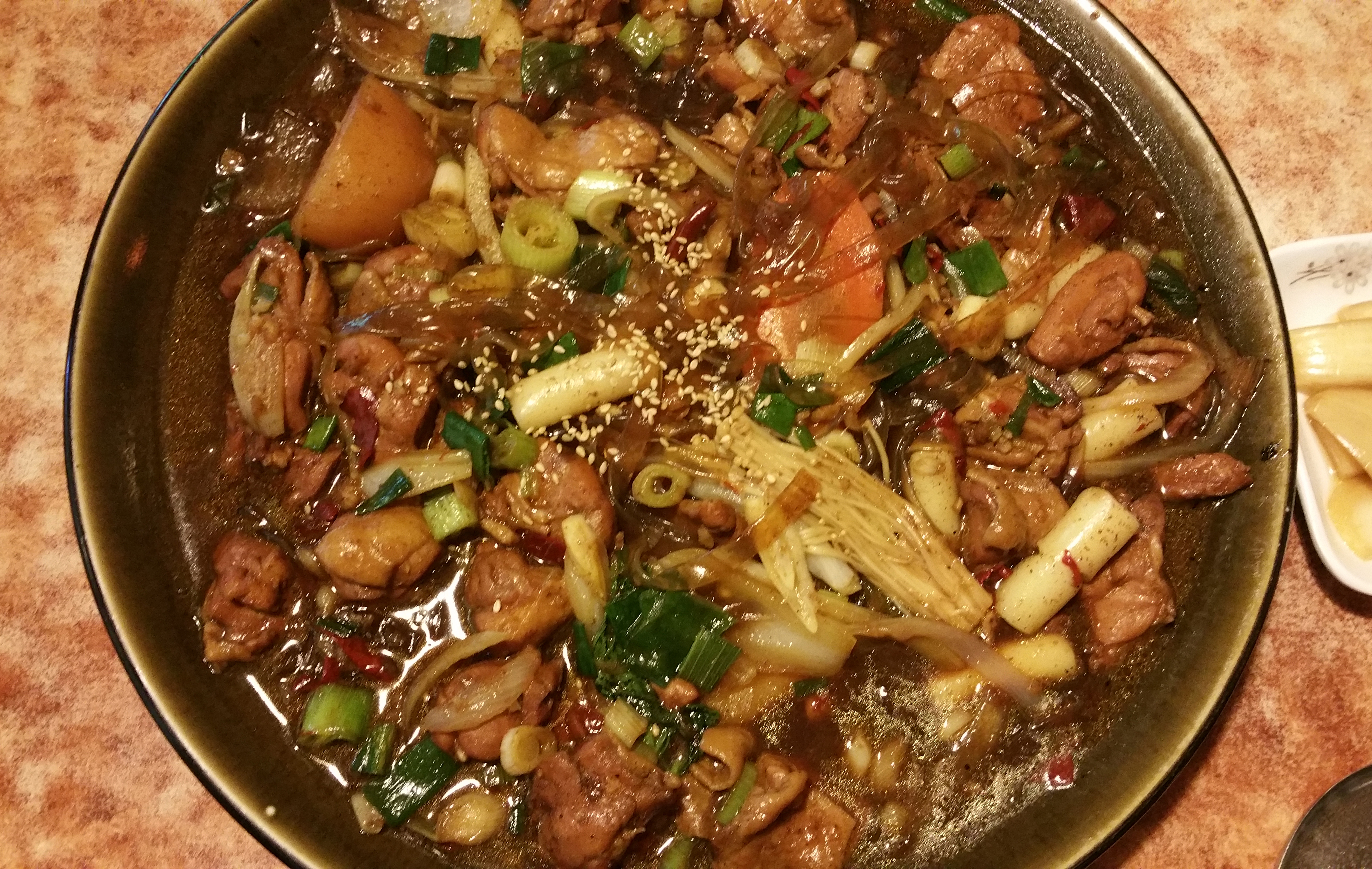
    Jjimdakk – A large (read HUGE) chicken dish mixed with sweet potato noodles, onions, and either gochujang or soy sauce
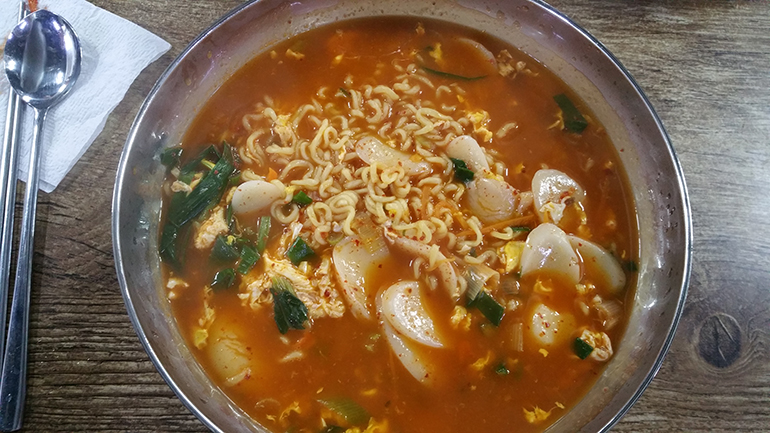
    Ddeokramyeon – Spicy ramen with rice cakes that is so simple you could make it at home
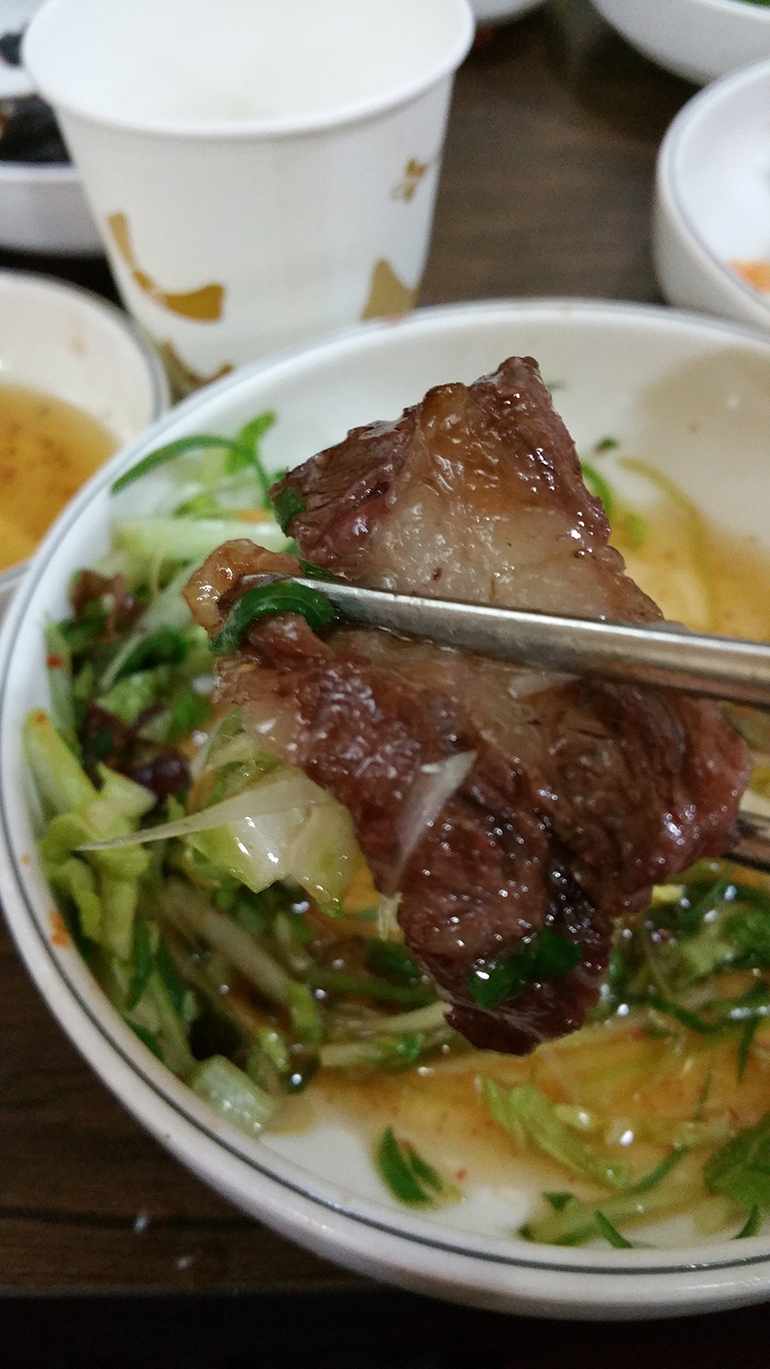
    Hanwoo – High quality Korean beef – try cooking it yourself on the grill!
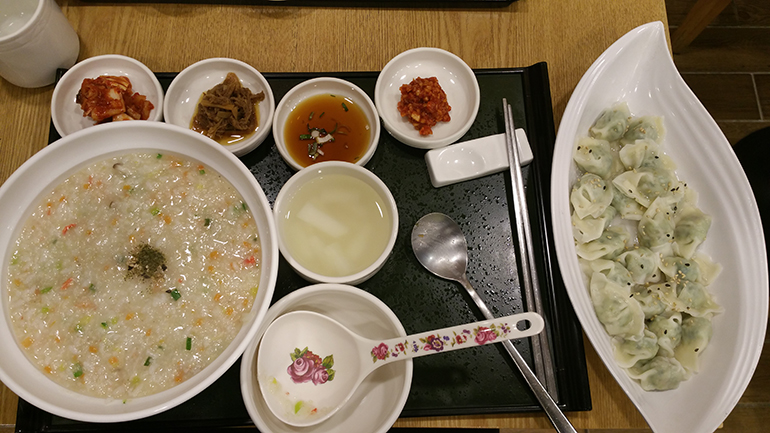
    Juk – Korean style savory porridge which is great to eat when you’re feeling sick
    Kalbitang – Beef bone stew which warms you right up on a cold rainy night
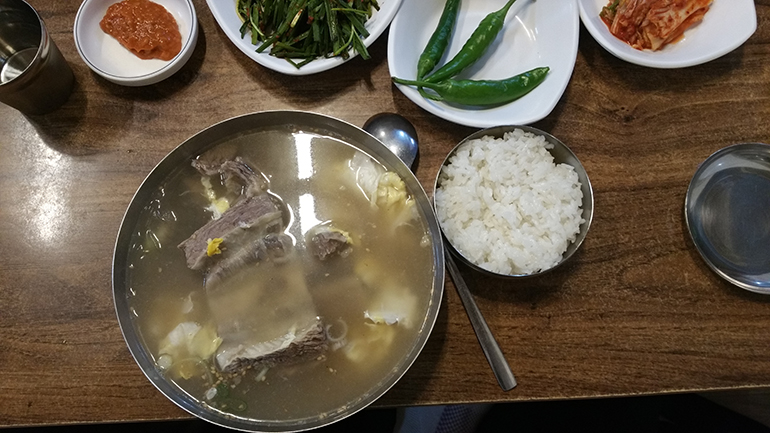
    What are your favorite South Korean food dishes? Share them in the comments below!


    About the Author

    I am from Minneapolis, Minnesota and am now living in Ulsan, Korea. I’m a total teaching newbie (having never taught in America) and teach 1st and 2nd grade middle school students; the equivalent of 7th and 8th graders. The advice I give in this article is gathered from two months of teaching these middle schoolers, so know that I am not a teaching expert. In these short months, I have already grown so much and my experiences in the classroom have made me a stronger, more confident teacher.  

    You can read more about my adventures in South Korea on my blog, Emily Teaches Abroad in Korea.
  • Understanding School Etiquette and Classroom Culture in South Korea

    Understanding School Etiquette and Classroom Culture in South Korea

    Every single school in South Korea is very different when it comes to classrooms and school culture. Actually, this is going to be true of every single aspect of teaching English in Korea, and my experience does not reflect on everyone’s experience.

    Teaching at a Korean middle school (where I teach) is very different than teaching at an elementary school. Besides the obvious difference of not teaching the same age, the “teaching with a co-teacher” experience will be much different as well. EPIK prepares you to teach with a co-teacher in that you learn different ways to manage a classroom collaboratively, how to plan lessons with another person, and how to communicate effectively with your new co-teacher.

    It is important to note that as the guest English teacher, you will nearly always defer to the Korean teacher’s judgment in most matters, even if you are in collaboration with the Korean teacher.

    My experience in teaching at a middle school with co-teachers is not collaborative at all. I do not plan lessons with my co-teachers and with the exception of my very first lesson, my co-teachers do not know exactly what I will be doing for each lesson. So, why is this?

    Co-Teaching as a Misleading Term

    Any answer I have is pure speculation, but it might be because middle school teachers in Korea go to school for the subject they teach and Elementary school teachers go to school to teach all subjects. Possibly, some English co-teachers just don’t know how to speak English and they need a native speaker there to help the students listen to English. It may also be because I only see my students once a week and some elementary school EPIK teachers see their students multiple times a week.

    Whatever the reason, the middle school “English conversation class” (the title of my class) is meant to be a time for students to practice their listening and speaking skills. I teach at two separate middle schools and at both schools, I am meant to teach the 2 to 4 pages of listening and speaking for each chapter.


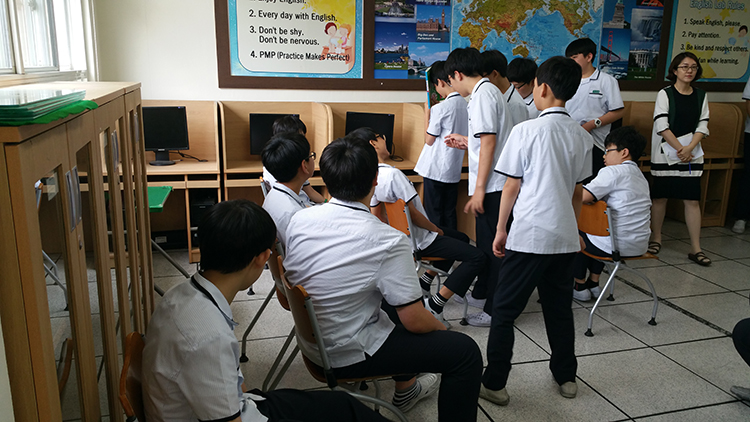
    My best behaved boys class playing the “blind navigation” game. You can see one of my co-teachers in the background.

    My first few weeks of teaching were very rough because I was constantly unsure of how I was doing (not because of anything my school or students did). I am a people-pleaser and like feedback from superiors and if you’re like me, you’re in for an unpleasant surprise.

    Your co-teachers will probably not give you feedback. When I asked my main co-teacher how I was doing after two months, she said: “you should include more games and not focus on the textbook so much.” That was it.

    That being said, my second school’s co-teachers will often remark about how much fun the students are having during different games and activities and that is always a really good sign.

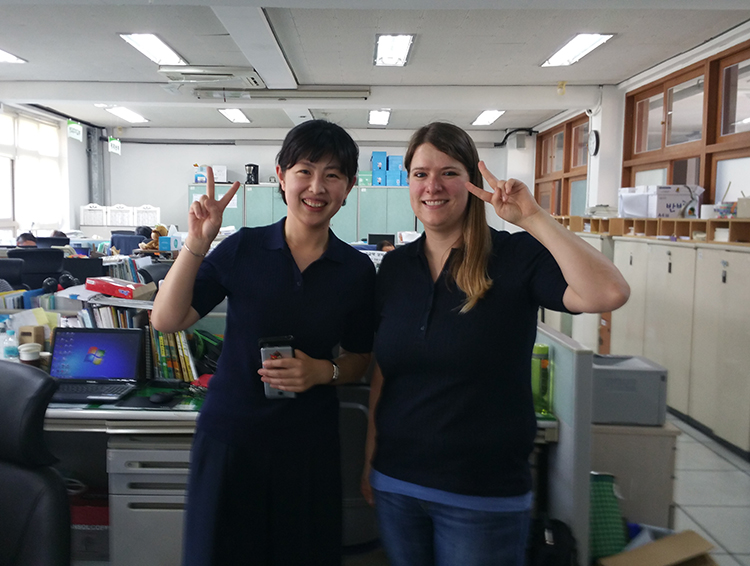
    Me and one of my coteachers from my second school. We accidentally wore the same shirt last week so we had to snap a pic of the “couple shirt” moment.

    So I don’t actually CO-teach. What do my co-teachers do then? Well, it depends on the teacher, but the majority of my co-teachers act as disciplinarians and translators when needed. I have one co-teacher who is extremely active in translating nearly every direction I have; and another who won’t translate even when I need her to for management purposes.

    Most middle school co-teachers will read the room and step in when they need to. This arrangement works very well for me because I can teach my students without feeling like I’m stepping on my co-teachers’ toes and my students can try to focus as much as they can on what I’m saying and doing.

    Understanding the School Culture and Etiquette

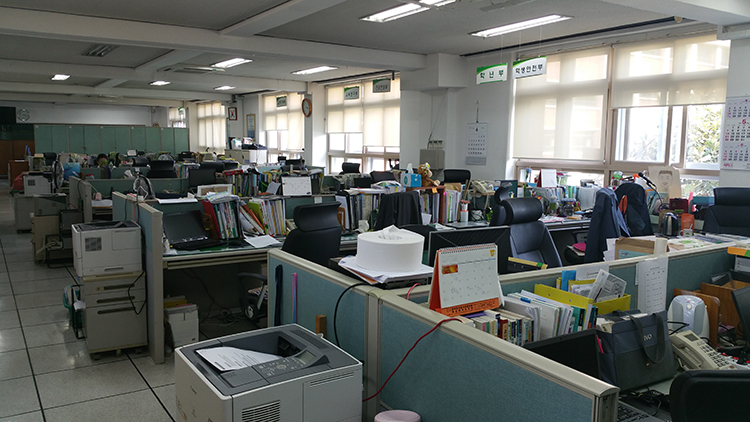
    The overall culture at each school is very different. It is very important to be open and friendly when you first start working because this will set the tone for how the other teachers (not only your co-teachers) perceive you. They do not see how you interact with your students in the classroom, so will judge you from the interactions with you in the hallways and teachers’ room.

    I would also recommend learning how to speak at least a little Korean.

    Phrases like:

    • annyeonghaseyo (hello!)
    • mannaseo bangapseumnida (Nice to meet you)
    • kamsahamnida (thank you)

    These are just some very basic phrases that could show you are interested in Korean culture and make your new coworkers realize that you want to get to know them, even if you can’t speak their language. Trust me on this, the effort goes a long way and at my second school, I’ve even made a few friends with the teachers.

    I do know some EPIK teachers feel very lonely at their schools because of how isolating it is to not speak the native language of the staff. On the other hand, I have friends who have become very close with the teachers. You just don’t know what kind of school atmosphere you will have until you’re there.

    Besides rudimentary etiquette such as removing your street shoes and wearing indoor slippers, the school etiquette is delicate and oftentimes not obvious. Koreans are programmed to bow to their elders and colleagues and thus whenever I see a Korean teacher in the hall, I must do the same.

    Now, I don’t outrightly bow (that might be seen as condescending), but I always incline my head slowly and sometimes say annyeonghaseyo. I am from America and I am so used to this motion now that I know when I go home, I’ll subconsciously nod at my friends and family, I just know it. It’s an odd habit, but you will form it pretty quickly.

    Another culture quirk is “letting your elders leave the lunch table first”. This is something I still haven’t quite figured out. When you eat lunch, you will probably eat with the other teachers. I generally use the rule who sat down at the same time as me to decide who “my elders” are in this situation.

    Being a foreigner and new to teaching, I am at the very bottom of the school hierarchy, so no matter who I am eating with, I nearly always wait for them to finish and stand up first before I leave the table. One of my co-teachers always tells me to “leave first,” but I will say this aspect of food culture is something that is very awkward for me because you just sit there.

    The empty teacher’s room at my second school.

    The last thing I’ll say about school culture is to make nice with the Principal and Vice Principal. The Vice Principal is in charge of the teachers at the school and has their desk in the main teachers’ rooms at both my schools. I rarely see the Principal, but see the Vice Principals every time I work. Even if they can’t speak a single word of English, it is important to show them kindness by smiling and saying annyeonghaseyo and yes, nodding, at them when you see them. They are the ones after all who will decide if you’re worth keeping around for another year!

    Korean classroom culture is something I never thought I’d get used to, and after nine and a half months, I can say that I’m still not 100% comfortable. Ever. The kids’ moods and ability to focus that day play a major role in how challenging the teaching day will be. I am lucky in that I have supportive co-teachers and friends to talk to about any situation that arises and hopefully, you will experience the same support when you get to Korea.

  • PHOTO ESSAY: This Could Be Your Life When You Teach English in South Korea

    PHOTO ESSAY: This Could Be Your Life When You Teach English in South Korea

    Teaching English in South Korea is more than gaining international work experience, or saving up money for a year to travel. This opportunity is also about jumping into a full-on cultural immersion adventure while living and working abroad.

    Greenheart Travel’s alumna teacher, Emily Balamut, is currently teaching in South Korea and shared her life in and outside of the classroom through her collection of photos. Check them out below and start picturing what your life could look like as an English teacher abroad!

    First Impressions of the Culture and Classroom in South Korea:

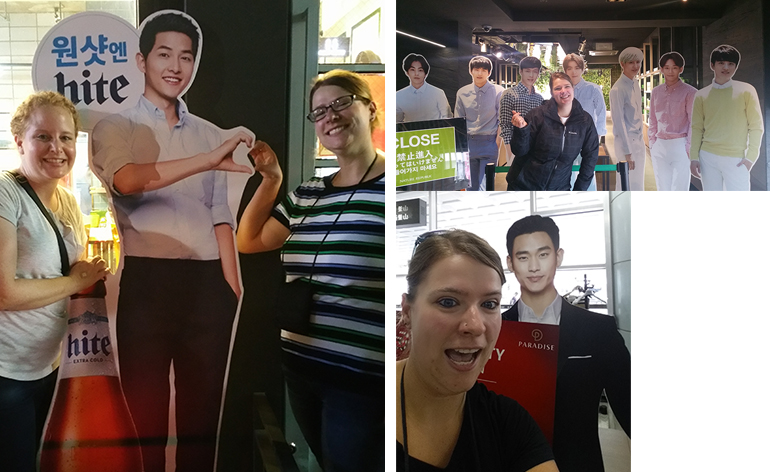
    When I first arrived in Korea, I was completely blown away by the amount of celebrity advertising I saw. It’s everywhere. After a month or so, I got used to it, but looking back at my first month here, I definitely felt excited and took tons of pictures with said celebrity advertising.

    Various photos with celebrities and ads of members of Exo.

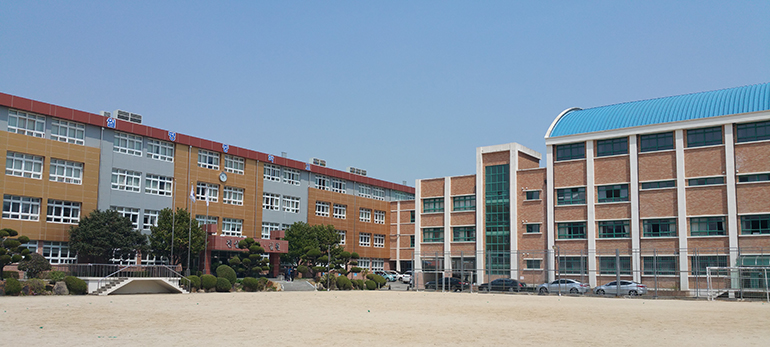
    As a middle school teacher in Ulsan, I teach at two separate schools.

    This one is Wolpyeong Middle School where I teach on Thursdays and Fridays.
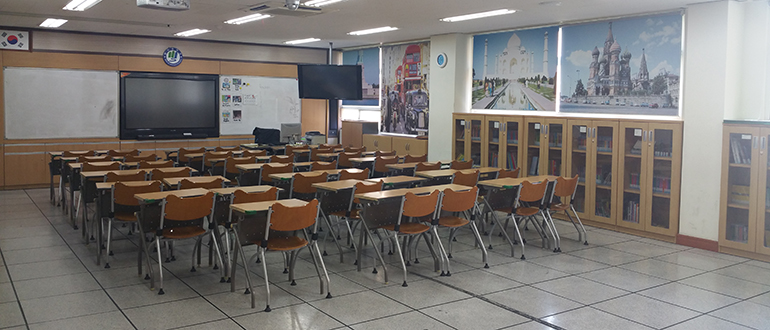
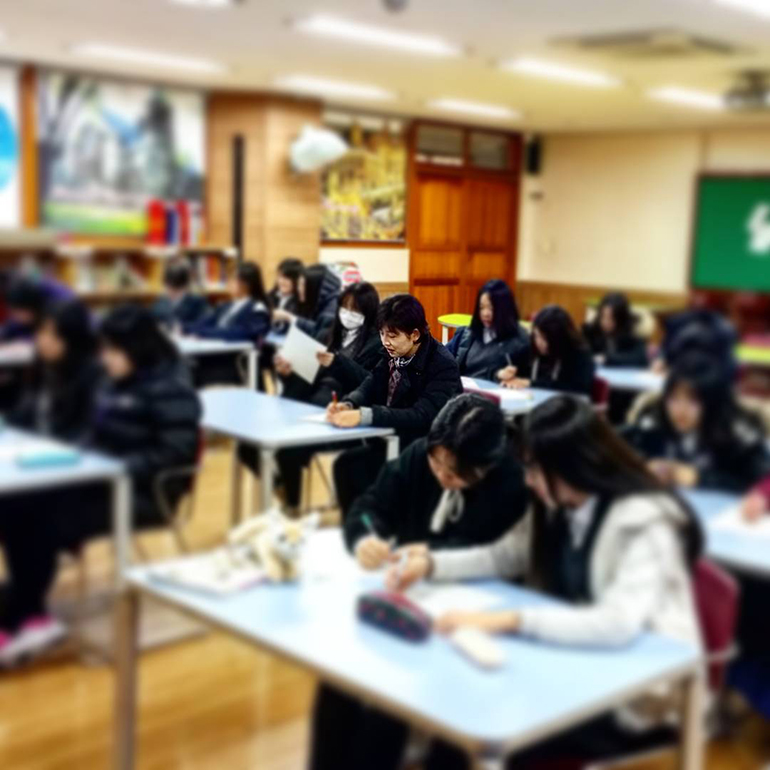
    This is the classroom at my first school, Munsu Middle School, where I spend Monday through Wednesday.

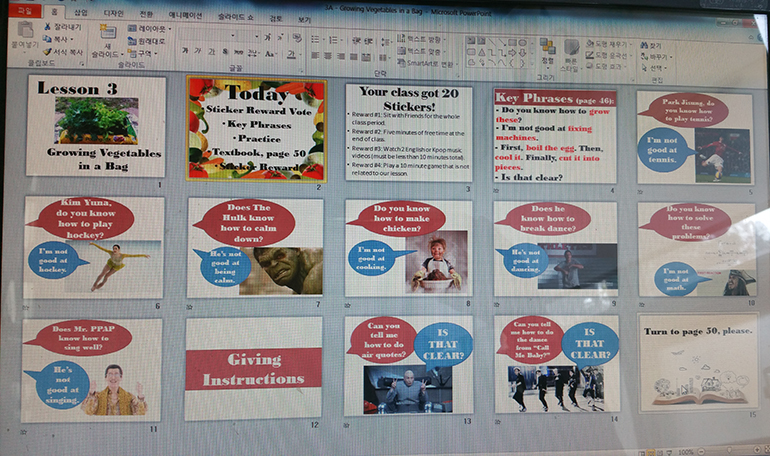
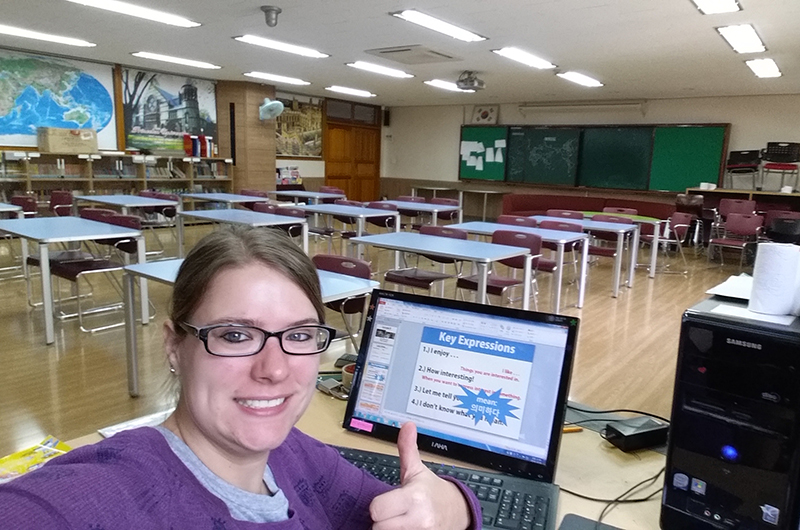
    I spend the vast majority of my week when I’m at school, but not teaching, creating Powerpoints for my lessons. This takes up most of my non-teaching hours.

    Here is an example of a lesson for my second grade class.

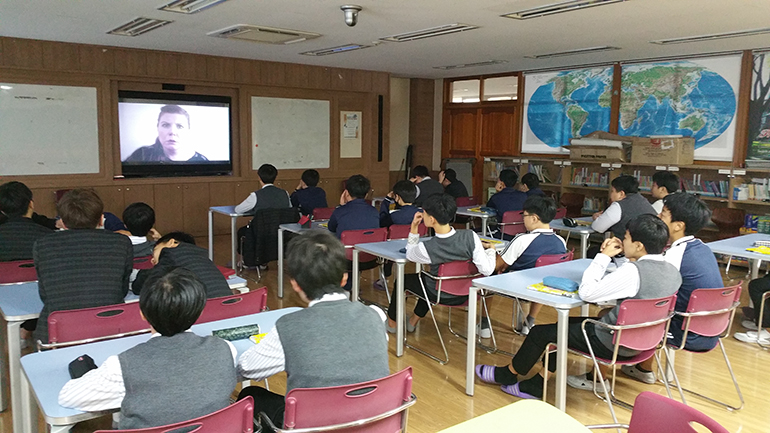
    I love taking pictures from the back of my classroom when my students are engaged in the something happening on the screen.

    Pictured here is one of my first grade classes at Wolpyeong from last semester watching a scary short film on Halloween.

    Life Outside My Classroom

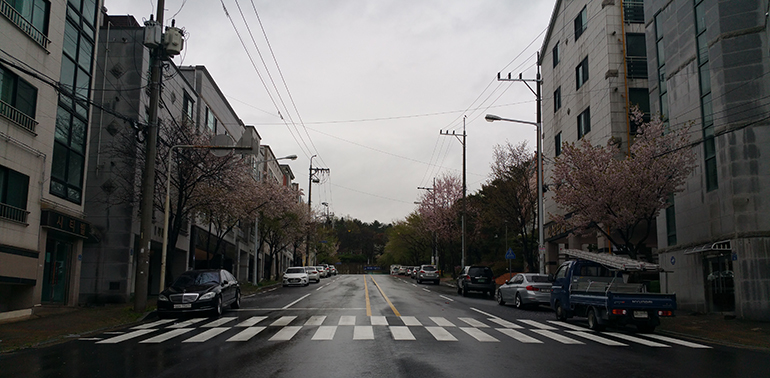
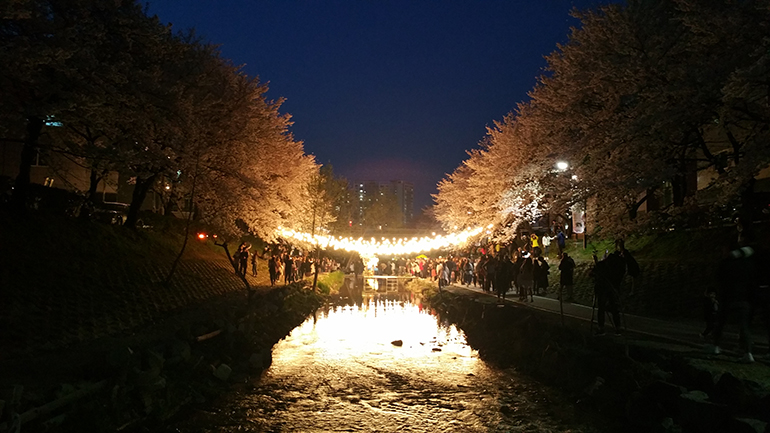
    The cherry blossoms near my apartment.

    Every year, the cherry blossoms bloom for about a week and I’m lucky enough to live near an area that celebrates this by lighting the beautiful flowers. Aren’t they gorgeous?

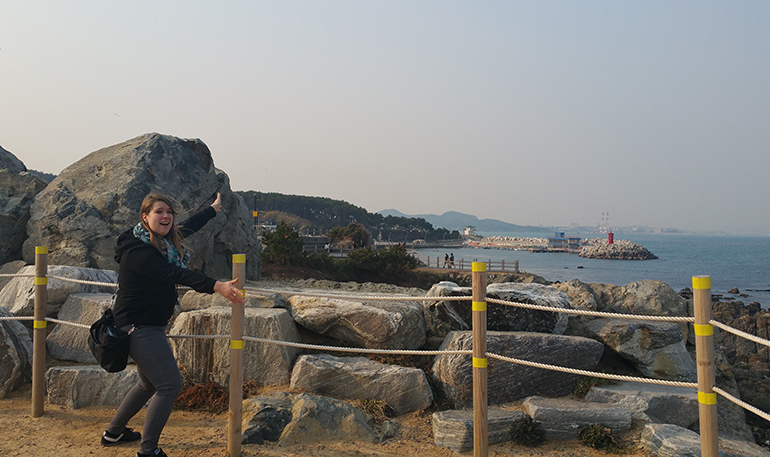
    A very popular attraction in Ulsan is Ilsan Beach and Daewangam Park located in Donggu.

    I love going to llsan on nice days and evenings and I plan on spending a lot of time hiking through the park and taking in even more breathtaking views of Ulsan this summer.

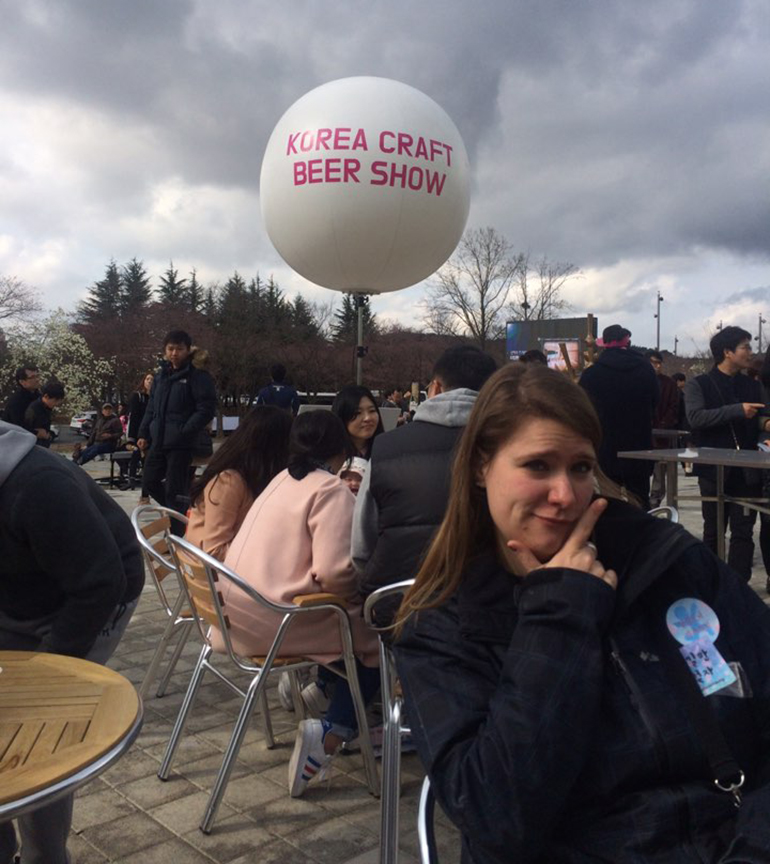
    One thing about Korea is that they really try to embrace western culture whenever possible. We happened to stumble upon this Craft Beer Show in Gyeongju one rainy, cold Saturday. All the craft beer really helped warm us up.

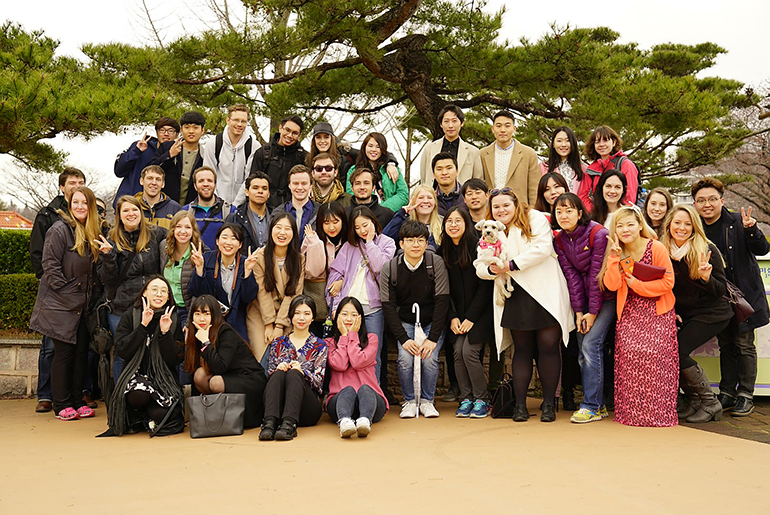
    My absolute favorite thing about Korea is the amount of amazing people I’ve met and encountered. This particular group met through language exchange meetings and decided to rent a bus and go see the cherry blossoms in Gyeongju. Unfortunately, the blossoms hadn’t bloomed yet, but we still had a super fun time walking around and getting to know each other.

    photo courtesy of Brandon Jo.

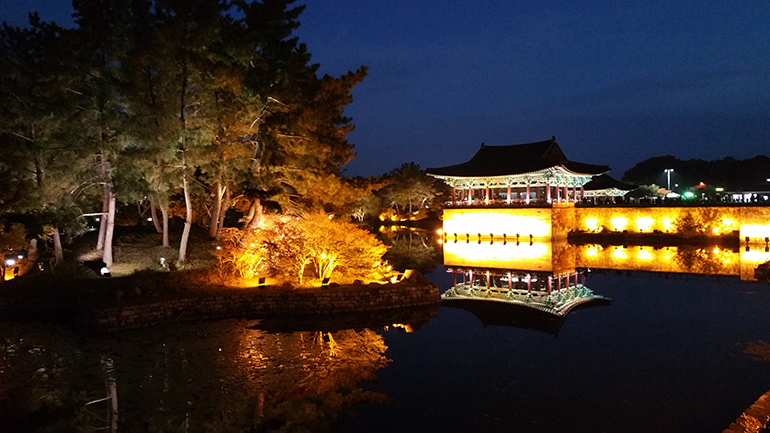
    Gyeongju is only about an hour away from Ulsan and has proven itself again and again to be a must-see destination for anyone living in the south (or anyone living in Korea). Gyeongju was the capital of Korea during the Shilla period and you can still see many historic sites such as Anapji (pictured), Cheomseongdae, and Bulguksa Temple.

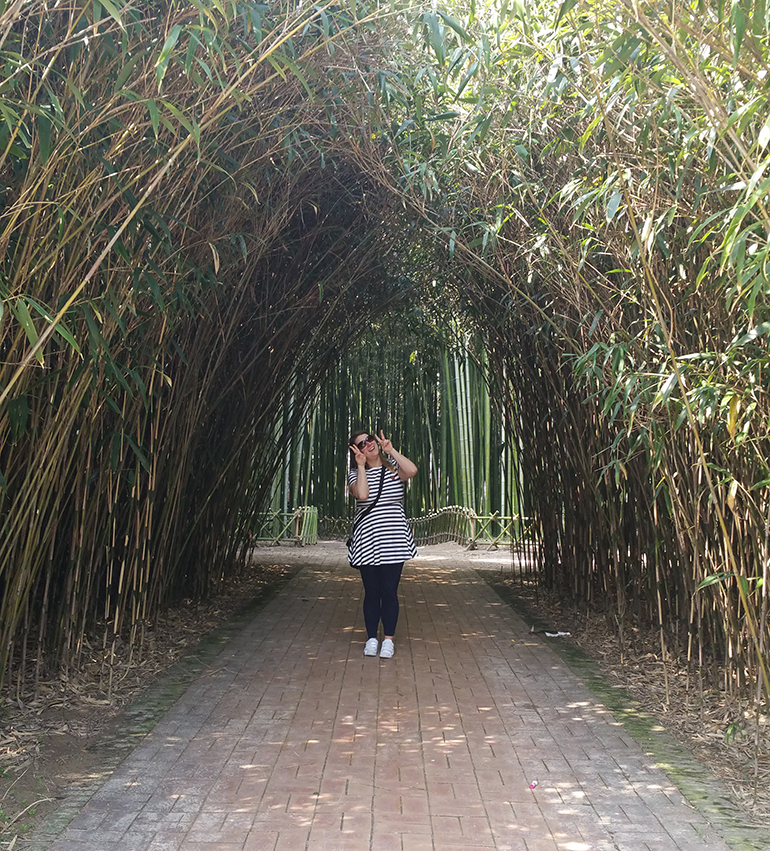
    A must-see in Ulsan is the Bamboo Forest located at Taehwagang Park. The perfect times to go are during the early spring or late fall to avoid the massive amounts of bugs that accumulate among the bamboo in the summer.

    Ganjeolgot is probably the most visited destination in Ulsan. It is the eastern-most point on the Korean peninsula, so many Koreans and foreigners come to Ganjeolgot on New Year’s Day to see the first sunrise of the year.

    Here I am showing you the rest of Ulsan

    What to Eat and Experience During Your Free Time in South Korea

    I spend a lot of time eating Western food in Korea. If you’re worried about finding some comfort food, don’t be too stressed. Korea loves western food even if they can’t do it quite the same.

    Honestly, I will never find a pizza to write home about, but I will say that chowing down on a big plate of pasta or biting into a burger, even if it’s sub-par, really helps fight homesickness.

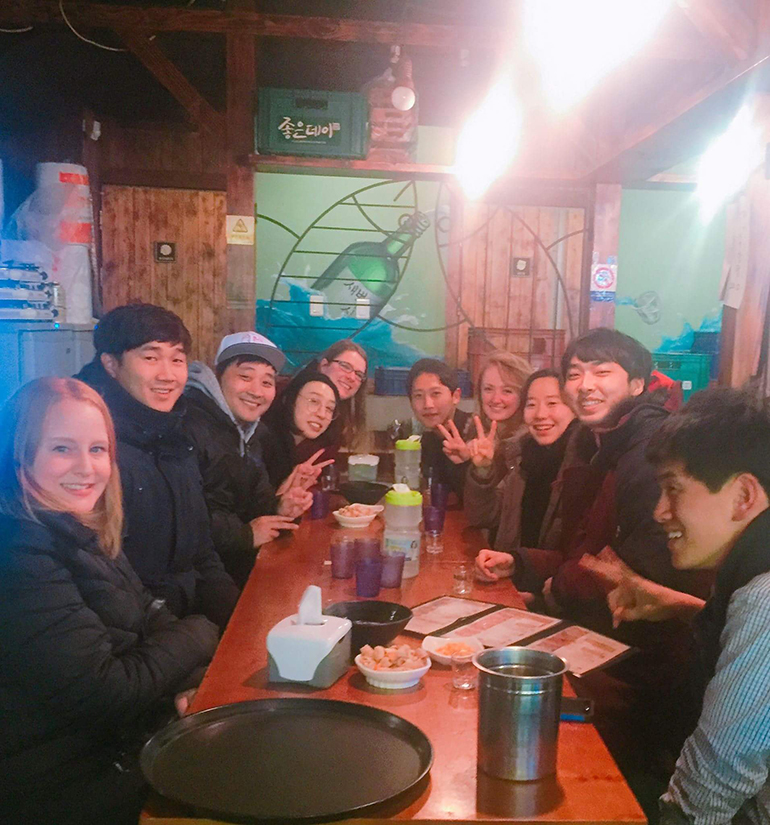
    Eating big meals with new friends is another way I like to spend my time in Korea. There’s honestly not a lot to do in terms of activities in Ulsan; most Koreans spend their time with friends at coffee shops and restaurants. I’ve really embraced that aspect of Korean culture.

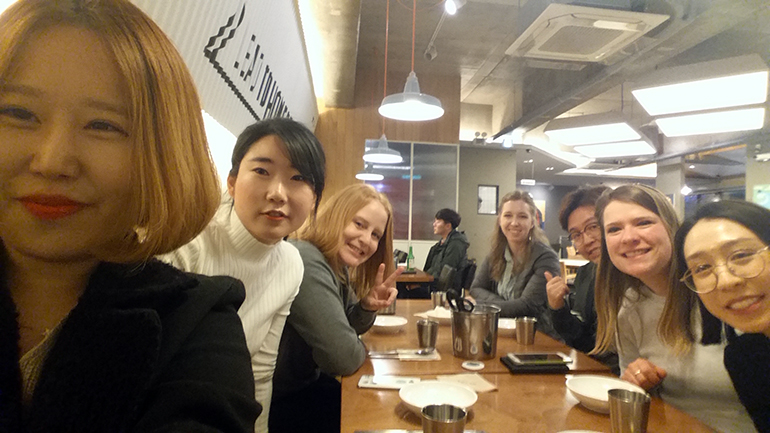
    Going to language exchange every week has helped me solidify new relationships and create even more friendships. I love meeting Korean people who share an interest in getting to know each other’s cultures. We also often go to second round at a bar or restaurant after the coffee shop for even more good times.

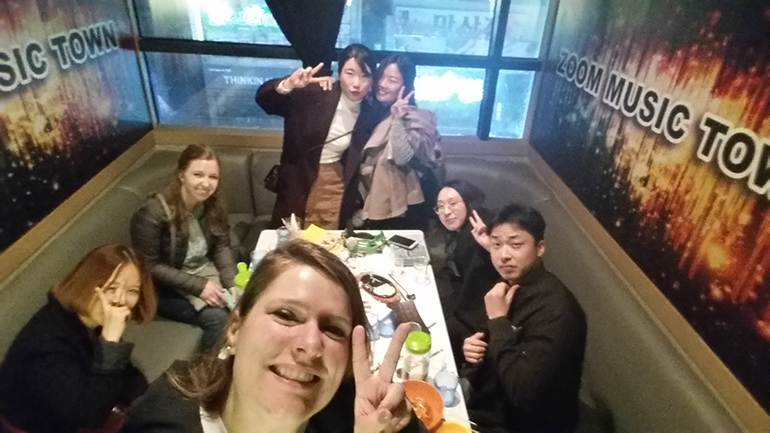
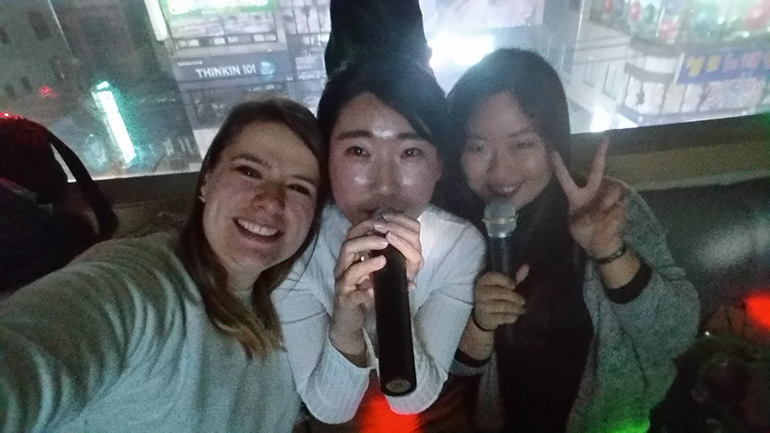
    Singing at a “song room” is hands-down my favorite activity in Korea. I sometimes go once a week!

    There are 3 types of “Song room:”

    • a room where you rent by the song
    • a typical “noraebang” (this does not serve alcohol)
    • and my favorite, “norae town” where you can order alcohol and tons of food
    I love singing, but even if you’re not good at it, it’s still quite the experience. You rent a room by the hour and just sing to your heart’s content.

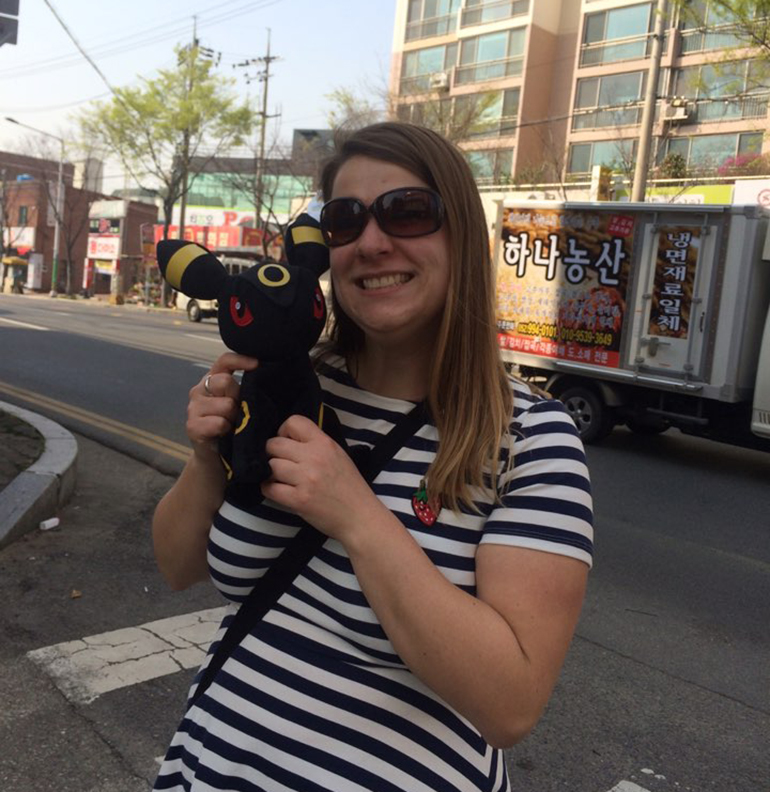
    Something that’s become a huge craze here are claw machines. Pokemon claw machines are the most popular and I often see young guys walking down the street with multiple Pokemon under their arms. This is my first and only catch so far and I’m incredibly proud of it!

    This one is called Umbreon in case you’re not up on the Pokemon names.

    Connecting with Korean Students

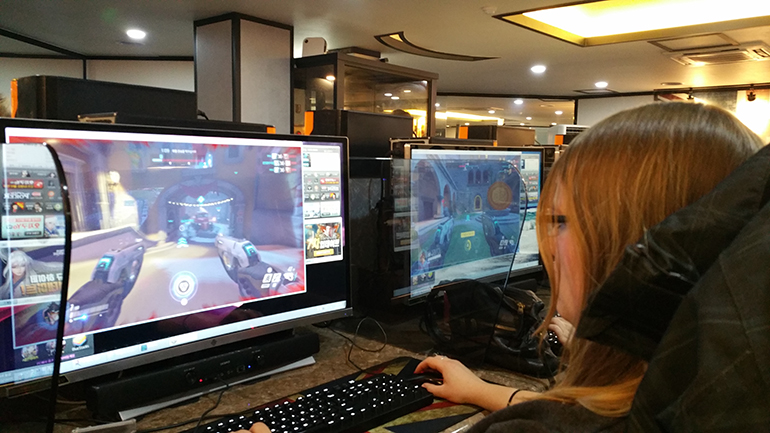
    You haven’t lived in Korea unless you have opened a Blizzard account and played at least one of the insanely popular computer games. My game of choice is Overwatch and many of my students feel very close to me since I made sure to tell them I play and since most of them do, too.

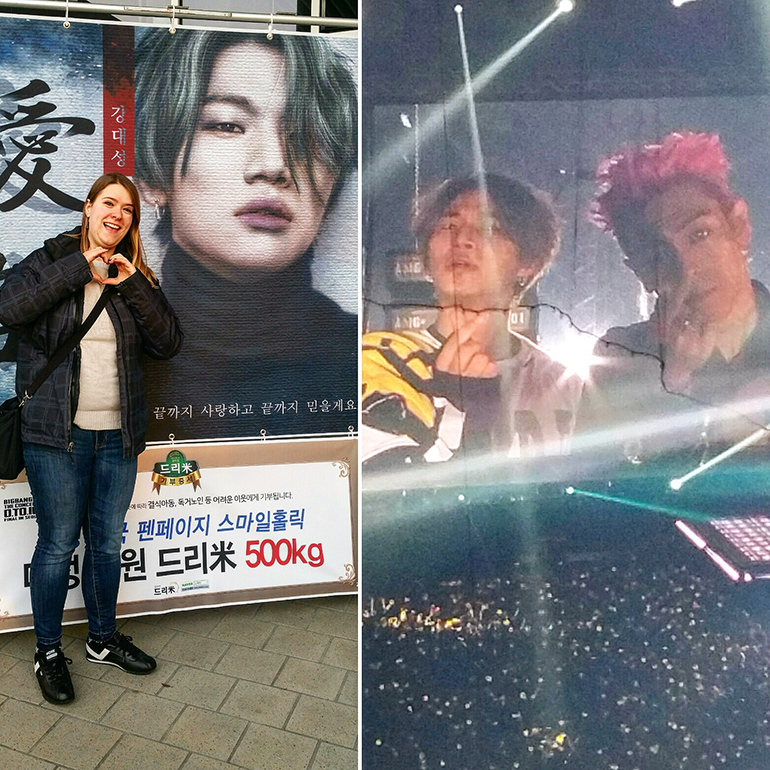
    It’s not for everyone, but try to at least appreciate KPop. It’s another way I have connected with my students and I tend to talk with them a lot about it. In January, I was able to see the last Big Bang concert for at least the next 2 or 3 years.

    I’m pictured here with my “bias” (favorite), Daesung.

    This is just a glimpse into life as an English teacher in South Korea. Living and working abroad is an amazing opportunity to gain professional experience, while also getting a chance to explore the culture as a local.

    About the Author

    I am from Minneapolis, Minnesota and am now living in Ulsan, Korea. I’m a total teaching newbie (having never taught in America) and teach 1st and 2nd grade middle school students; the equivalent of 7th and 8th graders. The advice I give in this article is gathered from two months of teaching these middle schoolers, so know that I am not a teaching expert. In these short months, I have already grown so much and my experiences in the classroom have made me a stronger, more confident teacher.  

    You can read more about my adventures in South Korea on my blog, Emily Teaches Abroad in Korea.
    How do you picture your life as an English teacher living abroad?

  • Expectations Vs. Reality of Teaching English in South Korea

    Expectations Vs. Reality of Teaching English in South Korea

    I racked my brain trying to remember all the times when I have been downright surprised by my experiences teaching English in South Korea. To be honest, there have been too many to count. Every day, something about my new reality catches me off guard or has me shake my head in frustration or resolve.

    The following tidbits are what I have found to be the most significant differences between my expectations and realities of life as a teacher abroad.

    Expectation: I would be placed in a POE (“Provincial or Rural Office of Education”) as opposed to an MOE (Metropolitan or City Office of Education).

    Reality: I am placed in a MOE.

    When applying for Korea, I didn’t have a preference to where I would be placed, and so I put “POE” as my preference. I thought this would give me a greater chance of being selected to work for EPIK since I felt sure that my lack of teaching experience would hinder my chances. When I got my placement, Ulsan, I was under the impression that it was in the province and I would be out in the boonies somewhere.

    Well, Ulsan, though the smallest of the MOEs, is still an MOE and I am currently enjoying the city life and most of what it offers. I think the reason I got the more desired MOE placement is that I got my application and documents in very early in the process which Greenheart Travel says massively helps your placement chances.

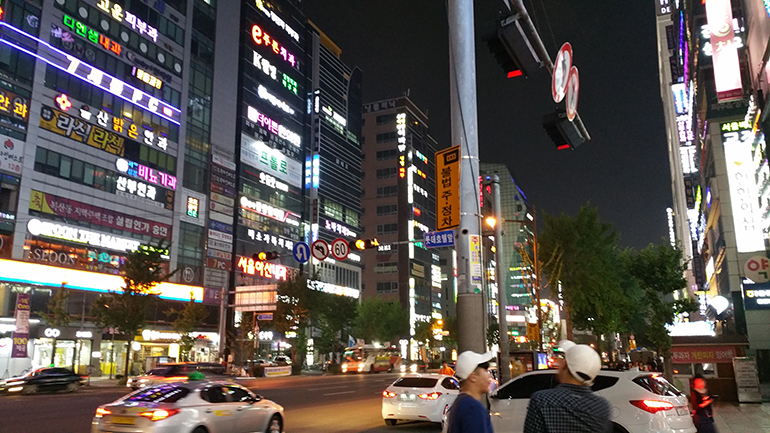
    Downtown Ulsan at night.
    Downtown Ulsan at night. This neighborhood is Samsandong and where we like to spend our weekend nights. Photo by alumna Emily Balamut.

    Expectation: I would be an elementary school teacher.

    Reality: I am a middle school teacher.

    Everything I had heard about EPIK led me to believe that I would be an elementary school teacher. From the initial research, to teacher testimony, to orientation – every avenue of information available steered me in the direction of elementary.

    Well, I got the surprise of my life when I saw “Middle School” on my placement form. About 8 of the 50 or so EPIK teachers in my orientation group also got middle school with 2 of those 8 also getting a high school. Middle school is daunting and intimidating, but I enjoy it so much because the kids can communicate with you even if they resist with all their might. And some of them will resist.

    You should also know that EPIK tells you everything you could POSSIBLY want to know about co-teaching during its many training sessions (both online and in person), but most of the middle school EPIK teachers I know (at least in Ulsan – everyone’s experiences vary widely, so don’t take this as fact) do not co-teach. What this means is that my Korean teachers do not plan lessons with me; they are, however, in the room and will deal with translation or discipline needs. I plan every lesson by myself and have complete control over what happens during my 45-minute long class periods. This Busan Ultimatum blog post helped me suss out a lot of feelings of teaching middle school.

    My co-teacher doesn't teach with me, but sometimes, she joins the students in the activities we're working on!
    My co-teacher doesn’t teach with me, but sometimes, she joins the students in the activities we’re working on! Here, we listened to American pop music and she got a worksheet to fill in the missing words. Photo by alumna Emily Balamut.

    Expectation: Teaching in Korea would give me a good idea as to what teaching in America would be like.

    Reality: It hasn’t.

    Because of the language barrier, teaching in Korea is not anything like it would be in America. I remember my classes from middle school and high school and realize that American schools are so different than Korean schools, and in such a way that teaching at one is in no way like teaching at the other.

    For example, middle school Korean students have classes separated by gender. My boys classes feel super out of control sometimes, and my girls classes feel quiet and uninterested. Each class is unique, but overall, I think it has been hard to get a good grasp on what it means to teach students in a way I can track their progress.

    My lessons work well for certain classes and not for others. I only see each class for 45 minutes a week, and even after teaching for a semester, I still don’t have a great idea of what level my students are; which is not what I imagine a native speaking teacher’s experience to be.

    Since I only teach listening and speaking, if my students don’t talk in class, I assume they are low-level English which is not a fair assumption because Korean schools place a greater emphasis on grammar than speaking. Also very important to note is that middle schoolers of any nationality are self-conscious and don’t want to be placed in the spotlight in case he or she makes a mistake. Only my most confident and outgoing students like to speak up in English.

    I find that the majority of my lessons end up geared more towards the outgoing students and in the coming year, I would like to work on ways to help all students feel more confident when speaking. Because of this hurdle while teaching, it’s been difficult for me to really get a hold of what it’s like teaching a group of students because sometimes I’m not even sure if they are taking in what I’m saying.

    Expectation: I wouldn’t have trouble getting supplies/groceries/home goods/etc.

    Reality: I have had trouble.

    The huge home goods store that most EPIK teachers are very familiar with is Homeplus (think Target times 150). I don’t live near a Homeplus, so I haven’t explored the massiveness of it much, but I suggest you locate your nearest one (or similar home goods store) because the apartment you receive through your contract may or may not come with everything you need.

    In your first week, you should take stock of everything the previous teacher left. Your contract with EPIK includes certain appliances (including a fridge and a microwave) and furniture (a TV and a table). However, it doesn’t include things like pillows, dishes, rice cookers, or cleaning supplies. As soon as you have a minute to go through everything left behind by the previous teacher, you should decide what appliances and other home goods you think will make your apartment feel more like home.

    For example, I had to buy a pillow, but I did not need to buy dishes or pots.  Most likely, your co-teacher will have a car and will offer to take you shopping on your first day in your new city or town. However, my co-teacher does not have a car, and she took me to the food mart, not an appliance store. You just don’t know what sort of help you’ll get on your first day, so don’t EXPECT anything.

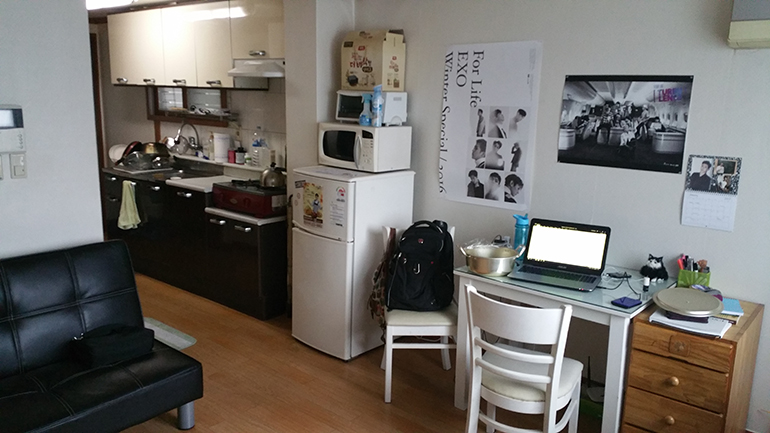
    My kitchen and part of my living room.
    My kitchen and part of my living room. You can see some of the furniture EPIK supplies. A stove-top, a microwave, fridge, desk, two chairs. I was lucky and got a futon and toaster oven (neither of those are included in the contract). Also not included in the contract are the awesome posters you see hanging. Photo by alumna Emily Balamut.

    From groceries to home goods, stores like Homeplus have it all when you don’t have a car; however, it’s very difficult to schlep all your new merchandise home. That being said, there’s always online shopping.

    If you’re used to cooking with an oven, I’m sorry, but our apartments do not come with one. I really love cooking and bought a Korean cookbook when I got here. It has been SUPER helpful in learning how to look for Korean ingredients, and how to use the ingredients to make super yummy, home-cooked meals – NONE of which require an oven! Our contract supplies a 2-burner stove-top and I use that for making ALL my meals.

    Many of my friends agree that one of the hardest things about being here is eating healthy at home. We often go out to eat 2 or 3 times a week, but that isn’t always the best option. Honestly, using this cookbook has helped me get over the culture shock involved in cooking entirely new ingredients in an unfamiliar way. And fortunately for me, a lot of Korean cooking is just tossing ingredients in a pot and letting it simmer – this is called jjigae or stew.

    Before coming to Korea, I wasn’t sure what to expect about my time abroad. There’s no way you’re going to know what it’s like teaching in a new country until you get there and experience it yourself. Everyone’s experience is different, but one thing every single EPIK teacher has learned from teaching in Korea is that this country is full of surprises.

    A saying my friends have adopted is: Korean surprise! It reminds us to let go of our expectations and go with the flow. This culture and its ways are confusing, frustrating, pleasantly surprising (24 hour noraebangs?) and sometimes just don’t make sense to foreigners. But unlike America, Korea is ancient and its history is steeped into the lifestyles and attitudes of its people and culture. The beauty of being here is learning to embrace those differences and grow from them, and that’s the reason we’re in Korea, right?

    It’s impossible to not have at least one or two expectations before moving to Korea. My advice for anyone coming to Korea is to recognize something is not what you expected, feel what you need to feel, and move on. If something doesn’t go the way you plan or the way you thought it would (some things just won’t), let go of the frustration in that moment because brooding over something negative is a sure-fire way to be unhappy in this new environment. It gets easier over time to recognize and embrace your new reality. Trust me.


    About Greenheart Travel’s guest blogger, Emily Balamut:

    I am from Minneapolis, Minnesota and am now living in Ulsan, Korea. I’m a total teaching newbie (having never taught in America) and teach 1st and 2nd grade middle school students; the equivalent of 7th and 8th graders. The advice I give in this article is gathered from two months of teaching these middle schoolers, so know that I am not a teaching expert. In these short months, I have already grown so much and my experiences in the classroom have made me a stronger, more confident teacher.  

    You can read more about my adventures in South Korea on my blog, Emily Teaches Abroad in Korea.
  • How to Survive Your First Week as an English Teacher in South Korea

    How to Survive Your First Week as an English Teacher in South Korea

    I am entering my fourth month of teaching English to Korean students in South Korea and trying to remember my first week of teaching is… difficult. What comes back to me are the nerves, the trepidation, the downright horror, and the anxiety. Everything is intimidating, people don’t speak your language, and why is everyone staring?! But it wasn’t all bad!

    Learning to go with the flow and being open to the new environment and culture helped shape my first week of school into a good experience.

    The following tips are a compilation of things that helped me make my first week positive and survivable.

    Learn Basic Workplace Greetings in Korean

    At the EPIK orientation, we learned five phrases in Korean: Hello, Nice to meet you, My name is…, I am from…, and I look forward to working with you. They taught every person at orientation these expressions, and at the time I didn’t know how helpful they would prove to be in my new school environment.

    My very first day of school was terrifying. I was presented to the entire staff of teachers and administration. When the principal handed me the microphone (accept everything from someone superior to you with TWO hands), I said those five phrases in Korean and everyone was shocked. After I uttered each phrase, the teachers would applaud! They were clearly shocked that I knew any Korean at all!

    Over time, I’ve learned that the principals were appreciative of the fact that I took the time to learn some Korean to make a good impression. It’s important to show your new coworkers that you are interested in their culture, and that you are excited to start working with them. Especially on the first day in your new school.

    emily-first-day-of-school
    Me on my first day of teaching English.

    Make an Exciting Self-Introduction

    My co-teacher told me that for my first week of classes I would be doing a self-introduction presentation for each class. I used PowerPoint and included “I enjoy…” as my main theme. I spent the first twenty minutes telling the students about myself – where I’m from, who my family is, and what I enjoy doing. I included tons of pictures of myself and the things I enjoy.

    I made sure to tell the kids that I love K-Pop and K-Dramas as well as included pictures of movies and TV shows I like that I knew they’d be familiar with and appreciate (Adventure Time, anyone?). The self-introduction is a great place to let the kids know who you are and where you come from. Believe me, they are SUPER interested in you.

    Let Them Ask You Questions (and Don’t Be Offended if They Seem Too Personal)

    I included five to ten minutes in my introduction where the students could ask me any questions they wanted. Beware: they get personal!

    “Do you have a boyfriend?” and “How old are you?” were by far the two most common questions.

    I answered every question they asked as I have no problem answering personal questions about myself; my favorite being if I could speak Korean.

    I ended up using five minutes of my presentation telling the students about how I can write and read Hangul (Korean), and I had three students tell me their names so I could write them on the board. Their reactions were priceless, and I will never forget their shock and awe and the huge rounds of applause I heard when I successfully wrote the names. If you can write in Korean, I highly suggest including it in your self-intro. I segued this into the fact that I cannot understand Korean, so if they need to say something to me, it should be in English!

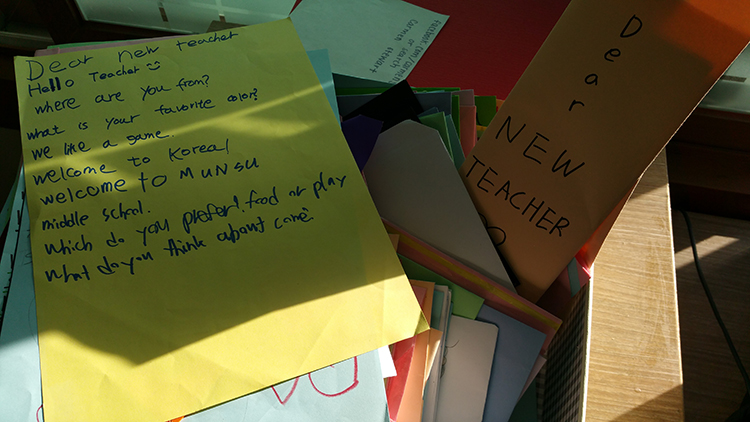
    letters-from-munsu
    A box of letters that the students wrote for me. It was the old English teacher’s idea and definitely made my first week so much more welcoming. I still look at those letters now that I know the kids better, and it makes me laugh so much. When I leave, I will definitely have the kids write the new teacher letters.

    Think About Ways to Motivate the Kids Before You Get to Korea

    This is advice I wish I had followed from the get-go, and really didn’t figure out until about three months in. And to be honest, I’m still trying to figure it out! It is impossible to know how your co-teachers will want to handle discipline and rewards, but it is important to think about possible ways to motivate students before you start teaching. Honestly, the hardest thing about teaching has been keeping the kids motivated, and I wish I could back to my first week of teaching and set a highly competitive (competition works wonders with middle-schoolers in Korea) reward system in place for the kids to get excited about.

    We are almost done with the school year and because my reward system (it’s based on a “five stamps for one candy” rule) is sub-par, many students aren’t motivated in the same way they were in the middle of the semester. Understandably, it would be tough to figure out an entire system over the weekend before you get into the classroom, but if you can research things before you get to Korea, I would suggest it. It’s something I wish I would have done just to be able to present something to my students upon arrival. Granted, if you decide to implement something a week or two in, that shouldn’t be a problem, either.

    These are just a few things I’d say to help ease the terror that is the first week of being an English teacher in Korea. I know teaching is uncomfortable and difficult and learning about a different culture’s workplace customs just adds to the pressure of teaching well. Try to remember that you’re there for the kids. They make it worth it, and even if they are little monsters some days, their curiosity and humor during that first week will help diminish the intimidation and make your first week fly by in the blink of an eye.


    About Greenheart Travel’s guest blogger, Emily Balamut:

    I am from Minneapolis, Minnesota and am now living in Ulsan, Korea. I’m a total teaching newbie (having never taught in America) and teach 1st and 2nd grade middle school students; the equivalent of 7th and 8th graders. The advice I give in this article is gathered from two months of teaching these middle schoolers, so know that I am not a teaching expert. In these short months, I have already grown so much and my experiences in the classroom have made me a stronger, more confident teacher.  

    You can read more about my adventures in South Korea on my blog, Emily Teaches Abroad in Korea.
  • 10 Tips for First-Time Teachers in South Korea

    10 Tips for First-Time Teachers in South Korea

    Deciding to teach English in South Korea was not hard, but teaching definitely has been. I teach at two middle schools in Ulsan, South Korea, where the kids are between 12 and 14 years old and, oh man, are they a handful!

    Having never taught in America, everything about my experience has been new. From living to working, every day has provided new, interesting, fun, and yes, extremely difficult challenges.  

    Here are tips that I’ve learned in my two months of teaching English in South Korea to middle schoolers:

    1. Learn to Speak Korean

    This is the best advice for anyone interested in coming to Korea to teach. Learn. Korean. Or at least how to read it. Learning Korean (I used this textbook as well) before coming here has helped me:

    • read maps
    • find bus stops
    • buy food 
    • impress my co-teachers and students
    • order food at restaurants

    You may end up in a small town and not be able to communicate with a single person (sometimes not even your co-teacher) very easily in English. At least reading Korean and sounding it out gives you some form of communication.

    2. Find Out Your Students’ Interests

    Do yourself a favor and start listening to K-Pop or playing Overwatch (an online computer game) if you haven’t already. Female Korean students are obsessed with K-Pop and the boys are obsessed with Overwatch. However, you have to be 14 to play Overwatch, so the elementary boys play other games.

    The most popular boy K-Pop groups are BTS and Exo (both my favorites!) and the most popular girl groups are Twice and I.O.I. Because I listened to K-Pop in America and actually love it, I have been able to connect with my students in an invaluable way.

    Here is one example of a popular K-Pop video:

    It is incredible how excited they were when they found out that I am interested in the same thing they are. Some students go out of their way to talk to me about it. In English. Which is mind-blowingly awesome.

    3. Be Flexible

    Nine times out of ten, I change my lesson plan after a class and sometimes change the lesson 3 or 4 times before the final class of the week. Let yourself make mistakes and don’t beat yourself up if a lesson plan fails miserably (speaking from experience here). The students will not hold it against you and neither will your co-teacher.

    The mark of a good teacher is the willingness to improve lessons and take note of what works and what doesn’t. Korea is a country of constant change and self-improvement; If your lessons reflect this, it’s only natural.

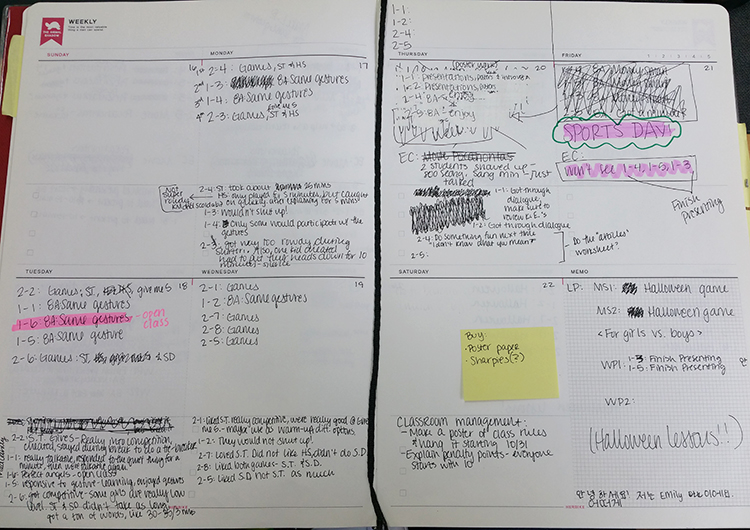
    lesson-plan-schedule
    What Emily’s weekly planner looks like.

    4. Don’t Take Anything Too Personally

    I would go home feeling horrible after a hard day thinking the students hate me and I’m the worst because the students acted up in class. Then, the next day, the same trouble-makers would be friendly with me in the hallways. It’s very important to remind yourself that there is a language barrier, and the things your students do in class is not a reflection of what they think of your personality. That being said, always try to be friendly with them in and out of class.

    5. Be Enthusiastic With the Students Even When You’re Feeling Horrible

    On bad days (you will have bad days), it’s hard to smile, but it makes a world of difference to engage your students. Since they don’t speak my language, I find they often read my facial expressions. I plaster on a smile and show them I’m happy to see them even if I’m feeling crummy on the inside.

    6. Let Authentic English Happen, Even if it’s Off Lesson

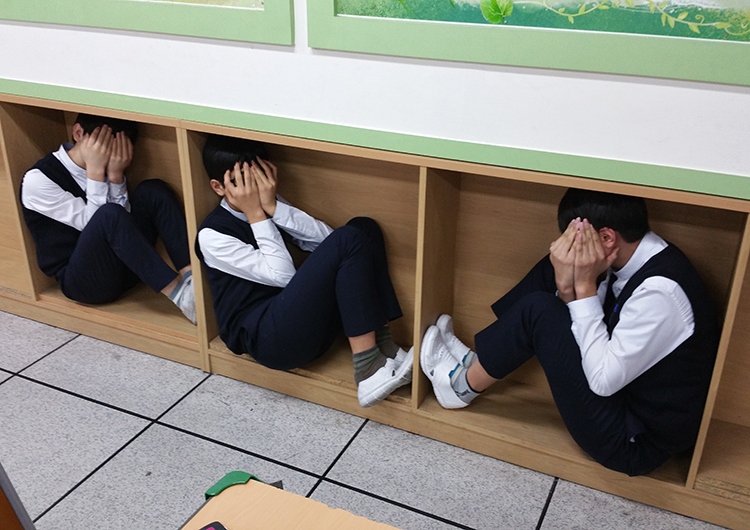
    Sometimes during class, students will talk to me in English that is off topic. Please let it happen. One of the hardest things about teaching English to Korean students is that they do NOT want to speak. Unless you have a class full of students that go to hagwons (English academies) after school, most students are reluctant to speak in English because they lack motivation or confidence in speaking up. When a student makes authentic English conversation happen in class, I let them speak. It benefits everyone.

    korean-boys-hiding-in-classroom

    7. Manipulate Your Lesson Plans to Increase Motivation

    Encouraging motivation to learn English is the biggest challenge any EFL teacher will face, and I found out the hard way that my extremely energetic 1st grade (7th grade) boys are not motivated by the same things as my super shy 1st grade girls. In middle school, competition is almost always a sure-fire way to get the kids excited about English, but the kind of competition is different with each class. This does take time to figure it out, but it helps make classes more effective.

    For instance, I played a  game of hot seat with my second grade boys and they loved being the center of attention. I did the same game with my 1st grade girls and they were terrified to be singled out and it made for a very uncomfortable 10 minutes. With the girls, it’s better to use group games where no one is actively alone in front of a group. I do think this is especially true for middle schoolers. They are extremely self-conscious and just want to be part of the group.

    8. Be Consistent

    Classroom management is extremely difficult with a language barrier. Luckily, you will have a co-teacher who will most likely deal with most aspects of the classroom management. If your co-teacher does not, however, come up with your own system of rewards which helps with motivation and consequences that keep your kids in line and then follow through every time.

    9. Learn the Art of Rejuvenation 

    What helps you relax? How do you rest? Learn the signs of your own exhaustion and deal with it accordingly. When your muscles ache, your mind and emotions will also. Trust me on this. Give yourself time to recuperate if you feel drained.

    student-sketch-of-emily-balamut
    A sketch of Emily by one of her students.

    10. Don’t Expect Miracles

    Leave any expectations you had at the door about how your students will act towards you or in class. Every single day is different. Once I learned to take my unrealistic expectations off of the students and put the expectations on myself, I started feeling much better and learned to have more fun with the students.

    Take everything you’ve read with a grain of salt. Every single English teacher’s experience is going to be different. You could get an amazing co-teacher who helps you every step of the way, or you could have a co-teacher who couldn’t care less. Your students could be maniacs or they could be perfect angels. It is impossible to plan for every outcome while teaching.

    I have learned from my two months here that it is best to have a good attitude and greet each class with enthusiasm because then I know I tried my best to create a safe environment for these kids to feel comfortable with English. As native English speakers, we give the students something they can’t get from their Korean teachers and that is invaluable to remember and utilize in your teaching.

    Do you have any tips for first-time teachers? Share them below!


    About Greenheart Travel’s guest blogger, Emily Balamut:

    I am from Minneapolis, Minnesota and am now living in Ulsan, Korea. I’m a total teaching newbie (having never taught in America) and teach 1st and 2nd grade middle school students; the equivalent of 7th and 8th graders. The advice I give in this article is gathered from two months of teaching these middle schoolers, so know that I am not a teaching expert. In these short months, I have already grown so much and my experiences in the classroom have made me a stronger, more confident teacher.  

    You can read more about my adventures in South Korea on my blog, Emily Teaches Abroad in Korea.
  • My EPIK Timeline: Everything You Could Want to Know about Teaching English

    My EPIK Timeline: Everything You Could Want to Know about Teaching English

    Teaching English in South Korea through the English Program in Korea (EPIK) is a fantastic opportunity for a number of reasons. Not only are salaries and incentives lucrative, foreign English teachers in Korea are highly respected, and Korean culture boasts to have some of the world’s most delicious traditions and cuisine. However, it’s becoming increasingly more competitive to land a job teaching in Korea. So, it comes as little surprise that the process of applying to teach with EPIK is quite extensive.
    Something that would have helped Emily Balamut, one of our newer teachers in Korea, during the application process would have been a specific timeline of how long it took, as well as what each step along the way entailed. That’s why she carefully outlined her experience from start to finish in a recent blog post. It includes tips on what you can do even before you begin applying, as well as beneficial advice such as stressing the importance of getting all your documents in on time.

    The most important advice I could give is to get your documents in as soon as possible…

    Read more about Emily’s process of applying to teach English in South Korea through Greenheart Travel!

  • Teach English in South Korea? Heck Yeah!

    Teach English in South Korea? Heck Yeah!

    Emily Balamut, one of our newest teachers in South Korea, shares, in her words, the all-you-should-know-about-my-decision to teach English in Korea spiel from her blog titled, “Emily Teaches in Korea”.

    First things first. My interest in South Korea stems from getting really into KDramas and KPop, or for all you non-in-the-know people, Korean Dramas and Korean Pop music. I mean, I got REALLY into KDramas. So much so, that I convinced myself to start learning the language…

    After learning the alphabet, I kept getting more and more excited about the prospect of using it in day to day life. With the combination of watching all the KDramas and learning the basis of the language, I realized I needed to go to Korea. It felt like the next step. But just visiting Korea didn’t feel like enough…

    Something you should know about me is that I’ve never really stepped out of my comfort zone…

    Read more about how Korean dramas and K-pop music ultimately led Emily to pursuing the opportunity to teach abroad in South Korea!