Author: Blythe Gilroy

  • A “Shout-Out” from Japan to ALL My Grandparents

    by Lily McFeeters, CCI Greenheart Travel High School Exchange Student in Japan

    Grampa Greg is still a young blood at 77. Nana Rosemary just celebrated her 80th birthday in May, and Poppop Stan celebrated his 90th last December. I am so fortunate to have such a loving relationship with all three of them. I would like to devote this next post to Obaa-san, my host grandmother.

    At 72 years old, Nobuyo Shono is quite an extraordinary person. Back in March when I first arrived at her home, it was so dark I could barely make out anything in the yard. The next morning, I found myself in Obaa-san’s garden full of many beautiful and exotic flowers. Across the front picture window there are so many hanging flowerpots that you can barely see outside.

    Besides folk dancing, Obaa-san, like most everyone in Japan, loves karaoke. She even goes to karaoke lessons. Everyone is in such a good mood after a good karaoke session, as evidenced by my host-sister, Momo-chan and Obaa-san!

    Early one Sunday morning, Obaa-san told me that she and I would be going to the Hyogo Prefectural Museum of History in Himeji, a city about 30 minutes to the south of Kakogawa, the city I’m living in. She explained that this was a special day for me because I would be dressed in a seven-layer replica of a junihitoe, a 12-layer kimono from the ninth century Heian Period, a rare opportunity for anyone. This sounded very exciting to me!

    Kimono translates simply as a “thing to wear.” Kimonos have been fashionable in Japan since the 8th century for both men and women, and many kimonos are considered great works of art. When we arrived at the museum, we watched another girl being fitted.

    Obaa-san commented that the fabric looked heavy and I agreed. Being dressed in the kimono required two women who took turns wrapping a sash around the girl’s waist. The women then added another layer of fabric. The sash, which had held the layer of fabric beneath it in place, was then removed, and so on, until all the layers had been added.

    Now it was my turn. I tied my hair up and tried to keep my arms in just the right place so that they stayed out of the way. As each layer was added, Obaa-san used my camera to document this once in a lifetime experience. The whole process only took about 10 minutes.

    The kimono actually felt heavier than I expected, a total of 13 kg (28+ lbs). The fabric was exquisite and probably very expensive. This kimono most certainly would take someone with real poise to gracefully maneuver from point A to point B.

    Even so, once I was fully dressed, I felt quite regal to be wearing such an ornate garment. I realized how lucky I was to be able to experience this and grateful to Obaa-san for making the arrangements.

    Next, a docent gave us a tour of the museum. Although my Japanese was not very fluent, I still enjoyed seeing the beautiful works of art on display.

    The city of Himeji is famous for its castle, Himeji Jō. We thought about going inside, but there was a two-hour wait and the top was under construction. So we walked around the park, which is known for its cherry blossoms.

    Obaa-san spotted a man dressed as a ninja but he appeared to be leaving the park. I chuckled to myself as I watched Obaa-san run after him calling in Japanese, “Ninja-san! Ninja-san! Can she take a picture with you?” Ninja-san graciously agreed to take a picture with me. He was really into his character!

    As if we hadn’t had enough adventure for one day, we then went to a Shinto shrine! Almost everyone in Japan observes some form of Shintoism, the ancient, indigenous religion of Japan. This was something I had really been looking forward to since before I came here.

    It was even more special to me because there was a wedding taking place. Suddenly the bride and her mother came out of the shrine. Just as they looked over at me, they smiled and I managed to snap their picture. I love this photo because it captures just how happy they were on this very festive occasion.

    I was completely exhausted by the end of this action-packed day. I don’t know how Obaa-san does it. Her cooking is always delicious. She makes all of our meals, including the bentō (home-packed lunches) Momo-chan and I take to school. She took me to the doctor 4 times when I was sick. (I’m better now!) She drives me to the store whenever I need anything. Above all, Obaa-san takes very good care of me, makes me feel very much at home, and I really enjoy talking with her in Japanese.

    She is taking me shopping this weekend to look for a yukata, a lighter, more casual, cotton kimono. These are much more affordable then traditional kimonos and are often worn during outdoor summer festivities. I will be wearing my yukata with my tea ceremony club in the school bunkasai (cultural festival), which takes place in mid-June.

    In Japan, the bathroom is a room with only a bathtub and shower head. When you bathe, you shower first, and once you’re clean, you take a bath. Because everyone is clean when they take a bath, family members use the same bathwater for that day. Obaa-san had Momo-chan and me take a bath together the first night I arrived. I thought it was because she wanted Momo-chan to show me how to use the bath fixtures properly. Later, Obaa-san explained to me that there is special meaning in bathing together since “you can’t hide anything.”

    Now I know I’m part of the family.
  • Cherry Blossoms, School Days and “Sailor” Uniforms in the First Weeks of Life in Japan

    by Lily McFeeters, CCI Greenheart Travel High School Exchange student in Japan

    Hisashiburi desu! (It’s been a long time!) So much has happened since my last post. A week before school started in Japan, we celebrated hanami, a centuries old custom which literally means “flower viewing.”  Everyone carefully watches the blossom forecast. Ideally, when the blossoms are in full bloom, friends and family gather together and enjoy a picnic under the cherry blossom trees, or sakura. Sakura embodies many symbolic cultural interpretations, one being that of the samurai.  Just as a cherry blossom suddenly falls to the ground upon reaching its peak, so too would the samurai readily sacrifice himself in his prime, should he be called upon to do so.

    For our picnic, Obaa-san prepared oden, a hot-pot stew made from various ingredients such as egg, tofu, daikon (white radish), and chikuwa (a tube-shaped fish cake), stewed in a soy-sauce flavored fish broth called dashi.

    The Japanese school year begins in April and ends in March. I bike thirty minutes to school everyday, rain or shine. All Japanese schools, both public and private, require a uniform that is unique to each school. My school has generously loaned me both a bicycle and a uniform, which can be quite expensive. Here we are on our first day, and no, we haven’t joined the navy; these are our winter school uniforms. Clearly, some students are very excited about their first day!

    I am a “first year” (sophomore equivalent, even though I am a senior at home), a.k.a., year 1, class 8, student number 41 (ichi-nen hachi-kumi yonjuu ichi-ban). There are 40 students in my class, about 20 girls and 20 boys. Here is a picture of me with my friends Megu (Megumi) and Rika. Now that it’s gotten warmer, some of us have opted to wear our summer uniforms.

    The first day of school, the other exchange students and I were asked to prepare a self-introduction for the entire 2nd and 3rd year classes. During the first school week, all the Japanese students have placements tests, so we exchange students, Aotea, Oliver, Camila and I, went to the library to prepare for our cultural presentation.

    Even though we were all a bit nervous, our presentations were well received. After the introductory ceremony, many students enthusiastically waved to us and said, “Hello!” or “Ohayo!” (Good morning!). Some students even leaned outside their classroom windows to show their appreciation.

    We occasionally have a half-day of school on Saturdays. On this day, my host sister, Momo-chan, the other three exchange students, and I went to the mall and ate takoyaki (fried dough with octopus).

    Afterwards, we went shopping and did purikura, shortened for Purinto Kurabu (Print Club). This is a popular photo booth stall where you take silly photos with your friends, like Aotea and me. The photos are then printed into really cool stickers.

    Thank you for all the comments, emails, and words of encouragement that I have been receiving from friends and relatives. It really means a lot to me. My host family has been so incredibly hospitable. I am having such a wonderful experience.

  • Hajimemashite! Meeting My Japanese Host Family

    by Lily McFeeters, CCI Greenheart Travel Exchange Student in Japan

    On our final day of orientation, we packed up our things and loaded onto a bus for a two-hour ride to the Shinkansen, also known as the Bullet Train. The Shinkansen is quite a modern marvel that connects Tokyo to most of Japan’s major cities. From Tokyo, I was approximately 500 miles from meeting my host family. With the Shinkansen capable of speeds up to 185 mph, it would take us a little over 90 minutes to get our stop, Hyogo, which is close to Osaka and Kyoto.

    It was very crowded when we arrived at the station. Yet we twenty plus exchange students with backpacks, carry-on luggage, and gifts for our host families somehow managed to make it through all the hustle and bustle. Once seated, we ate the obentos that our local coordinators from JFIE had brought for us. Obentos can be either homemade or store-bought boxed lunches. My consisted of vegetables, dumplings, fried shrimp, noodles, and rice with an umebōshi (pickled plum).

    Everyone’s excitement grew, as we got closer to our destinations. My stop was one of the last stops, so I watched as other students disembarked at their stations. Through the window, we could see the host families waiting on the platform. It was so heart-warming to watch everyone’s happy faces as they met their new families for the first time.

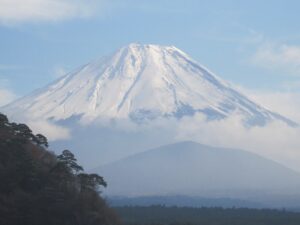
    Here’s Mt. Fuji from the train window. It looked spectacular!!

    Finally we reached my station. My heartbeat quickened with anticipation; it was my turn to meet my new family! I got off the train with the other three exchange students going to the same high school as me. Momo-chan, my host-sister, was waiting for me right outside the train on the platform. We said, “Hajimemashite!” to each other, which means, “How do you do?” or ” I am glad to meet you.” But this expression truly has the connotation of “first time,” in this case, meeting for the first time. After that, we didn’t have much to say, but smiling at each other was enough to know how we felt.  She was in her school uniform because everyone was going straight to school from the station with his or her host-families.

    Obaa-san, my host-grandmother, was waiting with the car outside the station by the train. I said the Japanese phrase, “Gokagetsu kan, yoroshiku onegaishimasu,” which translates to something like, “Please treat me kindly/take care of me for five months,” or “Best regards for five months.” I could tell how happy she was to see me, and I felt the same way. We loaded my luggage into the car and drove to my new high school, Kakogawa Kita Kōkōgakkō (abbreviated Kita Kō).

    The first thing we did at school was…take off our shoes! There was a genkan (entranceway) that had shelves for indoor and outdoor shoes. The principal, some teachers, and our local coordinator were all there to greet the new exchange students and their host families. The principal seemed very friendly. The exchange students went to his office, and he asked us questions like, “What do you think of Japan?” He used to be an English teacher so he said to me, “Oh, Lily, like Yuri? Yuri-chan!” Yuri is the Japanese word for the lily flower.

    When we went back into to the main room, there was tea waiting for us on the table.  But our host families had already drunk their tea. During orientation, we had been told we could not drink during class, not even water, so I wasn’t sure if we should drink tea during the discussion. I was rather conflicted about this, so as soon as there was a break in the discussion, I quickly drank it. The conversation seemed very formal because the principal and teachers were using honorific speech, a more reserved way of speaking.

    When we left the building, I noticed several students in their gym uniforms practicing for their club activity (bukatsu). We stared curiously at one another a little as we walked to the car.  Perhaps we will get to meet each other once the new school year starts in about ten days.

    Next up:  Juku (cram school) and ohanami (seeing the cherry blossoms)

    Read Lily’s first post about her arrival to Japan for her high school abroad program…