In this post, teacher becomes student as I share with you some valuable lessons I have learned while teaching English to 145 second grade Thai students in my little province of Pathum Thani. The beauty of diving head first into the unknown is that you will not be able to resurface without having gleaned at least a little bit of knowledge and understanding of what exists outside of your comfort zone.
During my mere three and a half months of teaching in Thailand, I have encountered a consistent wave of non-stop learning — and I am all the better for it. These lessons have varied in their importance and their impact, but they have all played a role in both helping me understand a culture different from my own, and helping me gain a better understanding of myself.
I’ve whittled away at my laundry list of lessons to create a shortlist of some of the most important takeaways teaching English in Thailand has taught me so far (let’s be real, this country still has so much more to teach me).
Here are four takeaways teaching English in Thailand has taught me:

1. Though my patience in America may have been above average, it definitely still has room to grow.
I have always believed that patience is one of the most important and commendable characteristics someone can possess. This belief has helped me strive toward a deeper sense of tolerance in the face of anything from minor irritations to serious frustrations. That being said, when life throws you curveball after curveball, it’s easy to let your patience wear down.
Since coming to Thailand, I have realized that it is so much more beneficial to let those curveballs build your patience instead of break it down. Arguably, the most important skill to possess as an ESL teacher is patience — especially when your audience is a crowd of rowdy seven year-olds who either talk too much or won’t talk at all.
After realizing how particularly vital this skill is to thriving as an English teacher in Thailand, I have been able to show an even more heightened sense of poise in the face of any trials or tribulations. It may seem like a tall order to expand your patience, but it becomes doable once you remember that you are a guest in this culture, and that having a short temper will not actually change anything. So, you may as well accept what you can’t change and be happy. Unsurprisingly, this newfound composure has helped me brace for challenges both inside and outside of the classroom.
2. The value of positivity is vastly underrated.
Wherever you may find yourself in life, you will encounter negativity. This is an unavoidable and unfortunate truth. However, the impact this negativity has on you wholly depends on your perception of it. Unfortunately, on my very first day on the job here, I quickly learned that the first coworker I had encountered had a chip on his shoulder regarding the school itself and frankly all things Thailand.
Having just been displaced from my comfortable first month in Chiang Mai surrounded by over 20 other Americans, to be plopped in a little village where I knew no one, was intimidating and scary and frankly had me questioning whether I had made the right decision in coming to teach in Thailand. This vulnerability opened me up to a heightened susceptibility to fall victim to negativity. Without knowing anyone or anything about this town, it was easy to let this abrasive coworker influence my time here in a less than ideal way. Luckily, I soon realized that filtering out toxic animosity would make me so much happier.
As I was struggling to get a hold on my culture shock, I quickly recognized that I would only come out of the rough patch if I looked at my new placement with rose-colored glasses. If you begin to look at a difficult situation with a positive outlook, it truly becomes a positive experience – fake it till you make it. Having banished this negativity, I can happily say I’m genuinely enjoying my Thai adventure, and I now have a meaningful lesson on the importance of positivity to carry with me wherever I may end up in the future.

3. Smile.
Impressions are so important, especially in the land of smiles. I have always tried to emit friendly vibes and possess an approachable demeanor, and luckily Thailand rewards this mindset. I’m a foreigner in a little town of Thailand where the majority of people speak little to no English. It is inevitable that I am under a microscope nearly 24/7. I’d rather not be caught frowning under this magnifying glass, so I’ve found it’s best to always be upbeat.
Of course I’m bound to have a day or two where I feel sad or tired or annoyed, but I will still slap a smile on my face, greet my Thai teachers, and crank up the energy for my students. Thailand places a lot of value on appearances (in the sense that it’s not really acceptable to look like a cranky curmudgeon).
It’s pretty simple actually — be amiable and be respectful, and you’ll experience the same pleasantries in return.

4. Accept the unknown.
This point is actually so important in terms of Thai culture. Leave behind everything you may be used to or may expect because, chances are, it will be different here. But this uncertainty makes the experience all the more exciting. Whether it be a result of Thai time, communication barriers, or differing values, you will often feel confused or out of control here. Western culture tends to favor being (or at least feeling) in control of any given situation, which is by no means a bad thing — it just certainly does not align with Thai culture.
The aforementioned “Thai time” is a concept that believes time is more of a suggestion than a set standard to which we should all adhere. Buses will run late. Students will show up to class late. Technicians will take two weeks to fix your computer instead of the promised three days. This laissez-faire belief that things will get done when they get done urges people (Westerners in particular) to release the ironclad grasp they have on their need to be in control.
In my teaching role, this factor of the “unknown” is especially prevalent. I’ve been told I had to report to school on a Saturday at 7:30 am , only finding out at 3:30 pm the day before. I’ve been told on a Tuesday that all of my lessons for that Friday (a day that I meet with all five of my classes) will be cancelled.
In Thailand, you may also run into uncertainty when faced with a need to converse with a Thai who knows minimal English. Have I eaten unidentifiable food due to a miscommunication in my order? Definitely — and on numerous occasions. However, once I came to accept these unknowns, I was liberated. I will not know nor will I always understand everything that happens in Thailand (or anywhere else in the world for that matter), but I’ve realized how freeing it is to let go of needing all the answers. This release of control allows Thailand to take me where it may and teach me a thing or two in the process.
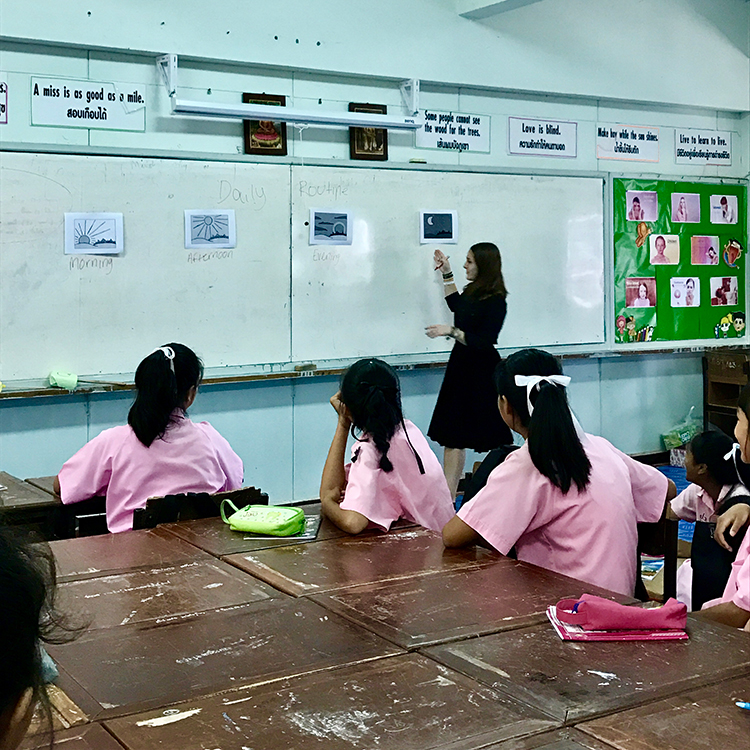
By the end of this post you’re probably wondering how I’m the teacher when Thailand seems to be doing all the teaching. The beauty of taking the plunge and coming to Thailand to teach English is that I’m achieving a sense of fulfillment by teaching young Thai students. But, in learning a new culture, I’m also achieving a sense of fulfillment by learning a lot about myself. Here’s to 2017 and looking forward to learning all that it has in store for me.
About the author:
Rachel is a native Chicagoan who recently graduated from Indiana University – Bloomington with a degree in Journalism and Spanish. After studying abroad in Seville, Spain and traveling throughout Europe during her time there, she was pleased to discover she had been bitten by the travel bug. She’s currently teaching English in Thailand to help sate her desire to discover new people, places, and cultures. You can follow her journey through her personal blog – Embellishing the Everyday.